Showing posts with label Chalcatzingo. Show all posts

Monday, July 2, 2018

The Secret Tunnels of Ancient Mexico and Central America

Just like Peru, with its countless legends of ancient tunnels and buried treasure, rumors of a vast ancient tunnel network that extends under much of Mexico and Central America are nearly as plentiful, many dating to a time earlier than that of the Spanish conquest. The Aztecs themselves believed that their ancestors had emerged from this mysterious underworld after a great cataclysm. In Aztec myths and legends, this underground world was known as Chicomoztoc, the “place of the seven caverns”. Maya creation stories also speak of the underground kingdom of Xibalba as a real, physical place, from which humanity had emerged at the dawn of time. Caves and ancient tunnels were believed to be the gates to this mysterious subterranean world.
The entrance to the Maya labyrinth of Yaxchilan, in Chiapas, a sprawling underground complex of chambers and corridors that may conceal the entrance to Edgar Cayce's fabulous Hall of Records. [Photo by Author]
What follows is a list of the most famous ancient cave and tunnel entrances found throughout Mexico and Central America. 

Texcoco – The palace of Nezahualcoyotl
The entrance to one of the many ancient tunnels that pierce the hill of Tezcotzingo. [Photo by Author]
The hill of Tezcotzingo, overlooking the ancient city of Texcoco, a short distance from Mexico City, contains the remains of several monolithic temples, rock-cut stairways and artificial aqueducts. It is believed that these remains date to the time of the king Nezahualcoyotl (1402-1472 AD), who built a magnificent palace on the hill. The unusual megalithic character and severe erosion of these structures may however point to an antiquity far more remote than the foundation of the city of Mexico by the Aztecs. Several cave entrances are visible on the hill of Tezcotzingo, all of which are presently blocked. When Bullock visited the ruins of Texcoco with the hill of Tezcotzingo in 1824, he could still admire the ruins of several pyramids and the great palace of the Kings of Texcoco on the hill, “of huge basaltic stones, carved and polished with the utmost exactness”. Bullock also described the whole mountain as “entirely perforated by artificial excavations”, in which immense riches were said to be buried, although for no amount of money his guides would accept to take him into the underground labyrinth. A tunnel entrance dug into one of the flanks of the hill leads through a steep descending passageway to an underground chamber. The entrance to another collapsed tunnel is visible below the floor of the chamber. It is rumored that this tunnel connects with another blocked passage exiting below a large monolithic basin known as the “Bath of the King”. 

A report of our 2016 expedition to Texcoco and Tezcotzingo can be found here.

Mexico City – The “Tomb of the Aztecs” on the hill of Chapultepec
The "Tomb of the Aztec Kings" inside Mexico City's Chapultepec Park. A V-shaped rock covered with mysterious hieroglyphs (to the left of the picture) is believed to conceal the entrance to a legendary tomb, inside a labyrinth of tunnels said to extent under much of present-day Mexico City. [Photo by Author]
Inside Mexico City's Chapultepec Park lies a little-known monolithic temple that was at some point known as the “Tomb of the Aztecs”. It contains a number of badly-defaced bas-reliefs believed to depict the Aztec king Moctezuma, mysterious hieroglyphs and what are possibly astronomical figures of the stars, the Sun and the Moon. There are legends of a tunnel entrance in the same area where the hieroglyphic carvings and a giant rock-cut serpent sculpture are found. This cave, known as Cincalco, was said to be an entrance to the underworld. According to the Aztec “Legend of the Suns”, it was through this cave that the mythical Toltec king Huemac entered the underworld. Other traditions speak of the legendary tomb of the Aztec kings, hidden inside a maze of tunnels deep underneath the hill of Chapultepec in present-day Mexico City. The entrance to the cave was apparently sealed during the course of the 1990’s, and is presently blocked by a concrete slab. 

Mexico City – The "Cueva del Diablo" on the Cerro de la Estrella

Many legends surround the so-called Cueva del Diablo or “Devil’s Cave” in Mexico City’s Cerro de la Estrella. The mountain, a prominent feature in the geography of the Valley of Mexico, was a sacred site since pre-Columbian times. Its name “Mountain of the Star”, suggests the hill may have served as a place of astronomical observations in antiquity. The remains of a large Aztec pyramid sit on its summit, where every 52 years a special ceremony was performed. During this celebration, known as the New Fire Ceremony, a giant fire was lighted to mark the beginning of a new calendar cycle. On the hill, among the many ancient petroglyphs and rock carvings, may be found the entrances to several caves. Of these, the Cueva del Diablo has a particularly sinister reputation due to mysterious disappearances and a number of reported attacks by what has been described as an “unknown creature”. The cave connects to a vast network of ancient lava tunnels whose true extent is presently unknown, but which are believed to run under much of present-day Mexico City.     

The underworld of Teotihuacan
A view into one of the chambers that are part of a maze of tunnels extending for miles under the ancient city of Teotihuacan. [Photo by Author]
Dry-stone walls and burn marks on the ceiling of some of the caves and tunnels are evidence of a long human occupation of the mysterious underworld of Teotihuacan. [Photo by Author]
The ancient metropolis of Teotihuacan contains three massive pyramids and hundreds of structures. At its height, between the 2nd and 5th Century AD, it was home to an estimated population of 250,000, which would have made it the largest ancient city in the pre-Columbian world – the “Rome of America”. Yet, the identity of the city's original builders is still shrouded in mystery. 
A vast labyrinth of man-made tunnels and natural lava caves exists under the ancient metropolis, believed to extend for tens if not hundreds of miles. In 1880, the French archaeologist and explorer Desiré Charnay was among the first Europeans to penetrate the underground labyrinth of Teotihuacan. In his book “The ancient cities of the new world” he recalls having been led to what he described as the entrance to a cavernous quarry, some two and a half miles west of the pyramid of the Moon. There, several galleries branched off in different directions, leading to vast halls and chambers. Charnay also described an immense chamber with a dome-like ceiling, filled with human remains, which he considered to be the mausoleum of the mysterious race who built Teotihuacan and its great pyramids. Charnay speculated that the tunnels had originally been quarries, and were only at a later point converted into catacombs. Some of the tunnels that Charnay explored were remarkable for their straightness and perfection of construction, with one in particular said to run on a straight line to Amecameca, some 40 miles to the South-East. 
The entrance to the original tunnel system first entered by Charnay in the late 19th Century is presently lost, but more tunnel entrances can be found a short distance to the East of the pyramid of the Sun. In 2017 we explored a section of these tunnels, finding a system of interconnected chambers and blocked passageways that seem to extend for an unknown distance in the direction of the Pyramids of the Sun and the Moon. Reports also exist of vast tunnels under the Cerro Gordo mountain and in the nearby Tlapacique mountain range, where the openings of several air shafts or “respiraderos” point to the existence of yet more unexplored tunnels and chambers.   
  
In the 1950s, archaeologist René Millon speculated that the largest pyramids at Teotihuacan were built on top of vast underground cavities. He even found evidence of what he described as a “huge sealed pit” under the pyramid of the Sun, which he believed could lead to a tomb of immense proportions. Another tunnel was explored under the pyramid of the Sun in 1971, terminating in a clover-leaf chamber. This seems, however, to bear no relationship with Millon’s supposed tomb.  
In 2003, torrential rains revealed the entrance to another ancient tunnel under the Pyramid of the Feathered Serpent. Vast quantities of liquid mercury, mysterious pyrite spherules and over 50,000 buried artifacts were recovered from the excavation, yet no burial could be found. At present, the function of these tunnels is unknown, It is possible that they may have formed part of a secret representation of the Underworld extending for miles under the ancient city of Teotihuacan.  

A report of our latest explorations into the mysterious underworld of Teotihuacan can be found here.

  
The subterraneans of Xochicalco
A view of the Acropolis of Xochicalco from the lower terrace. The entrances to several caves and man-made tunnels are visible at the base of the cliff, penetrating deeply into the rock face [Photo by Author]
A map drawn at the beginning of the last century of a section of the subterraneans of Xochicalco, forming part of the so-called "Cave of the Sun". [Courtesy: INAH]
The ancient ruins of Xochicalco sit on top of an artificially terraced hill pierced by a number of ancient tunnels and mysterious passageways. There is evidence on the hill of earlier megalithic structures, including some enormous retaining walls built in the polygonal/ cyclopean style. The Pyramid of the Feathered Serpents, which dominates the Acropolis of Xochicalco, is also built of immense basalt stone blocks, decorated with sculptured panels that may allude to the destruction and later resurrection of the original “homeland of the Gods”. 

In another article we even suggest that the hieroglyphs of the pyramid of Xochicalco may in fact tell the history of Atlantis - Read the complete article here

The so-called “Cave of the Sun” is the only one of several tunnel entrances under the hill of Xochicalco that are presently open to the public. The main attraction of this tunnel system is a small, nearly circular chamber with an opening on top. On the day of the Spring and Autumn equinox, a ray of sun enters through the opening in the roof to light up the chamber. More blocked tunnel entrances can be found along the cliff face. In 1791, the learned scholar father Alzate y Ramirez was the first to report the existence of the tunnels or “subterraneans” of Xochicalco. One in particular he describesd as consisting of several “hallways” connected by winding stairways. The Indians accompanying the father on his expedition warned him that a person entering the underground labyrinth in the early hours of the morning would still not be able to find an end to it by sundown, or risk getting forever lost in the maze of tunnels and chambers.   

Mitla's Temple of Doom  and the Liyobaa cavern
A view into one of the tombs of Mitla - Note the extremely fine workmanship of the stones and the mosaic panels on the walls. [Photo by Author]
Another view of the chambers and tunnels under one of the main palaces of Mitla. A similar cruciform structure may have served as the antechamber to the legendary Liyobaa cavern, believed to be an entrance to the underworld. [Photo by Author]
The ancient city of Mitla was the capital of a powerful Mixtec kingdom between the 9th and the 12th Century AD. A sacred city, it contained a number of palaces, pyramids and structures that are today found in varying states of preservation. Mitla is particularly famous for the elaborate stone mosaics that decorate its ancient buildings. Some immense megaliths, some of which weighing in excess of 45 tons, were employed in the construction of the ancient palaces, including a number of curious monolithic columns. 
Several tombs have been found under the main ceremonial structures of Mitla, the largest and most elaborate ones mimicking the architecture of the palaces above ground. The subterranean chambers are built of stone, finely cut and dressed, and frequently contain monolithic pillars and stone mosaics. 
The entrance to a subterranean chamber at Yagul, another archaeological site located in the vicinity of Mitla. [Photo by Author]
At Yagul, a short distance from Mitla, one can still see the entrances to many ancient tunnels believed to be part of an immense necropolis. [Photo by Author]
The first European reports of the ruins of Mitla date to the early 16th Century. One such report by a father Torquemada describes an immense cavern by the name of Liyobaa, believed to be the entrance to the underworld and the seat of a powerful oracle of the dead that was famous throughout the land. This cave was entered though a set of three underground chambers located under the main palace of Mitla, which father Torquemada calls the “Palace of the Living and the Dead”. The cave itself was said to extend for more than 30 leagues underground, its roof supported by pillars. The Spanish priests sealed the entrance to the cave and built a church on the former site of the palace. Portions of the ancient building, including some immense monolithic lintels and columns, can still be appreciated under the small colonial parish church of Mitla. A comparison with the floor plan and orientation of the other surviving palaces of Mitla suggests that the entrance to the underground chambers and the cavern of Liyobaa would be found in the approximate location occupied by the altar of the present day Church.
Other tunnels and cruciform tombs built of enormous megalithic stone blocks are found at Guiaroo and Xaagá. An ancient tunnel under the ruined hacienda of Xaagá is said to run all the way to Mitla, a distance of nearly 5 miles, its walls built of interlocking stone blocks like the underground tombs of Mitla.
The entrance to an ancient tunnel under the old Hacienda of Xaagá, said to run for nearly 5 kilometers in the direction of the ancient city Mitla. [Photo by Author]
Inside another ancient tunnel in Xaagá. The tunnel leads to a large cruciform chamber from where local tradition has it that a now blocked well-shaft in the floor communicates with a fabulous cavern. [Photo by Author]
Read here a full report of our 2017 expedition to Mitla and Xaagá. 
    
The tunnels of El Barreno in Morelia
A 1956 sketch of the tunnels under El Barreno, in Morelia [Source: http://www.espejel.com/] 
In 1956, the excavations of an ancient mound in the outskirts of Morelia, in central Mexico, revealed a curious structure formed of giant blocks of stone apparently fused or melted together. What was at first believed to be a small volcanic outcrop, known to locals as “El Barreno”, turned out to be an ancient pyramid of unknown age. An opening close to the northern side of the pyramid revealed the entrance to an ancient tunnel with rock-cut steps. According to a map that was published by Dr. Jesús García Tapias shortly after his discovery of the tunnels, the main tunnel led to a large domed chamber from which at least 6 other passageways ran in different directions. After following some of the passages for a distance of over 500 meters, it was found that they were either blocked or flooded. Over the course of the last decade, the pyramid and its tunnels have been largely obliterated by the growth of the city of Morelia. It is however possible that future excavations in the area will again reveal one of the original entrances. 

The lost caves of Chalcatzingo
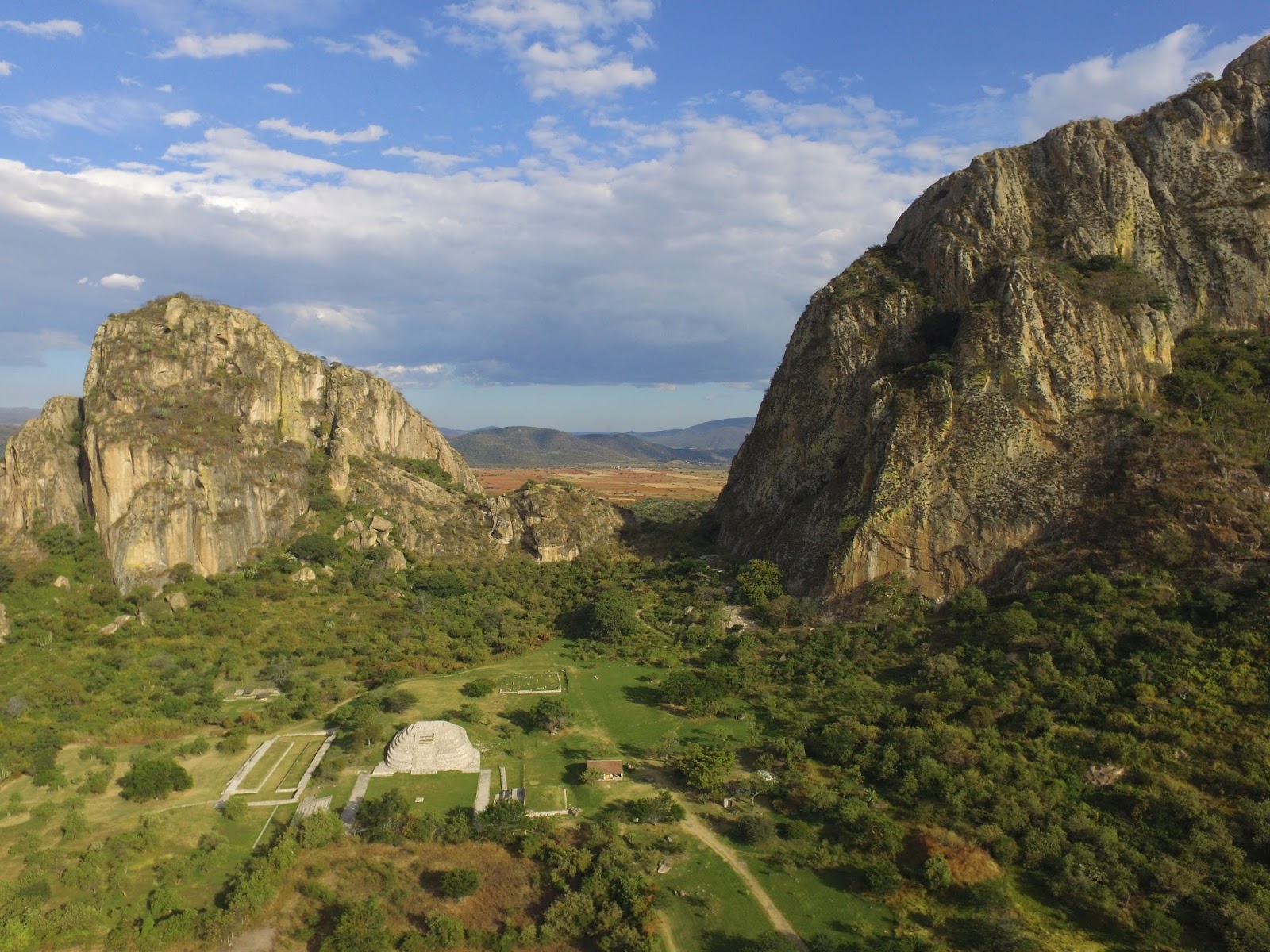
The stunning natural landscape of Chalcatzingo, with the Olmec pyramid and ceremonial center in the foreground. In this aerial picture, the openings of several caves are visible in the cliff face of the Cerro Chalcatzingo (to the right) and the nearby Cerro Delgado (to the left). [Photo by Author]
The most famous Olmec bas-relief found at Chalcatzingo. It shows a seated figure holding a bundle of scrolls or a tablet inside a cave from which emanate curious guts of steam or air. [Photo by Author]
Chalcatzingo is an ancient site of the Olmec civilization located in the Valley of Morelos, in Central Mexico. It dates to between the 7th and 5th Century B.C., with the ruins of a large ceremonial center which included at one time two pyramids, a ballcourt, various altars and sculptured monuments. Chalcatzingo is mostly famous for its rich rock-art, consisting of a number of carved bas-reliefs distributed along the slopes of the Cerro Chalcatzingo. One of the most famous carvings, known as “El Rey” (The King) depicts a man seated on a throne inside a cave. The mysterious figure is holding an object resembling a tablet or a scroll. Another scene illustrates a procession of torch-bearers, also seemingly taking place inside a cave, with more of the curious objects resembling tablets or scrolls. There is every hint that a sacred cave existed at Chalcatzingo, where sacred objects may have been stored. No such cave is known at the site, but a drone fly-over conducted in 2017 along the slopes of the Cerro Chalcatzingo revealed a few possible cave entrances. These are located high on the cliff-face, in a nearly inaccessible position. It is presently unknown what these caves may contain and how deep they reach inside the mountain. 

In this article we discuss the possible existence of an ancient and still undiscovered cavern at Chalcatzingo which may hold evidence of the visit of ancient "Gods". 

The Sacred Valley of Tepoztlán and Daniel Ruzo
The mysterious "Sphinx" of Tlayocapan, near Tepoztlán. According to Daniel Ruzo this rock was artificially carved in the shape of a giant sphinx by a lost civilization he called Masma. Ruzo believed this civilization was also responsible for the incredible rock sculptures of Marcahuasi, in Peru. The entrance to a large natural cave can be seen on one side of the rock formation. [Photo by Author]
Tepoztlán is a small town located some 50 kilometers south of Mexico City. Here, amidst a setting of stunning natural beauty and unusual rock formations, the famous Peruvian explorer Daniel Ruzo believed he had discovered the remains of a “sacred forest” of giant rock sculptures similar to the ones he had himself discovered at Marcahuasi, in Peru, just a few years earlier. These sculptures, which Ruzo believed could be thousands if not tens of thousands of years old, formed a coherent sequence that in his mind described the full cycle of development of present humanity and of the races that preceded it. Ruzo also believed that some of the sculptures were in fact “portals” to a labyrinthine network of tunnels where the knowledge of the ancient races had been stored since time immemorial for the benefit of a future humanity. Many people perceive a strange energy or magnetism in Tepoztlán and its “Sacred Valley” is one of the places in the world with the highest frequency of UFO sightings and other unexplained phenomena.

The Loltun cave in Yucatan

The Loltun cave in Yucatan is a large natural cavern containing extensive layers of human occupation that date back to the last ice age, some 10,000 years ago. It also contains a set of cave paintings attributed to the Maya civilization from the Pre-Classic period or even older. The true extent of this labyrinthine system of caves and passages is presently unknown, although nearly two kilometers of the entire cave systems have been mapped and explored. In 1931, the American archaeologist Robert Stacy-Judd recounted a strange episode in which, after getting lost in the cave, he was rescued by a mysterious man dressed like a Maya priest and carrying a torch. The explorer even managed to take a photograph of the mysterious “hermit”, which appeared in several newspapers at the time. There are rumors of secret passages inside the cave, and of a blocked rock-cut tunnel which is believed to lead into a deeper, unexplored section of the cave where great treasures are said to be buried.    

The secret tunnels of Aké and Izamal

Within the Maya region of Yucatan, early explorers like Brasseur de Bourbourg, Stephens and Catherwood reported the existence of extensive ancient tunnels at both Aké and Izamal. These sites contain a number of pyramids and megalithic structures unlike any other in the Maya region, which may point to great antiquity. A sacred cave exists under the pyramid of Kinich Kakmo in Izamal, where a tunnel is said to connect this pyramid (the 3rd largest in Mesoamerica and one of the largest in the world, with a base of 195 by 173 meters and a height of 35 meters) with another that existed on the site now occupied by the great Franciscan convent of Izamal. Brasseur de Bourbourg explored and left a description of this tunnel in the early 1800’s, in which he mentioned a great subterranean chamber and more blocked passageways built of immense megalithic stones. Unfortunately, there seems to be no record of the existence of these tunnels in any of the more recent publications on the ruins of Izamal and Aké. 

The Maya labyrinths: Oxkintok, Toniná, Yaxchilan
The entrance to the ancient Maya labyrinth of Toniná, in Chiapas also known as the "Palace of the Underworld". [Photo by Author]
Caves played a fundamental role in Maya cosmology as physical representations of the Underworld. At Oxkintok, Palenque, Toniná and Yaxchilan, mysterious labyrinthine passageways built underneath some of the main pyramids and palaces were meant to serve as symbolic caverns for initiation ceremonies related to the cult of death and of the ancestors. These Maya labyrinths contain underground corridors and chambers of unknown function. Over the course of initiation ceremonies, the candidate would be led in complete darkness through the confusing maze of passages and corridors, possibly under the influence of psychoactive drugs. Perhaps the best example of Maya labyrinths is found at Yaxchilan, along the Usumacinta river. The labyrinth extends on three separate levels and contains a number of blocked passages and chambers. At Oxkintok, a labyrinthine network of tunnels exists under one of the main pyramids, known as the Satunsat (meaning “Place where one gets lost”); while the labyrinth of Toniná, although of comparatively more limited extent, is perhaps the most monumental of all, with high corbelled ceilings that warranted it the name of “Palace of the Underworld”. For unknown reasons, these labyrinths were deliberately sealed or filled with rubble (as in the case of Toniná) during the 7th Century AD. It has been speculated that this occurred during a veritable “Underground revolution” during which the old gods of the Underworld were literally overthrown and their subterranean temples either sealed or destroyed.      

A lost Hall of Records at Yaxchilan?
A view of Structure 19 at Yaxchilan, being the main entrance to the labyrinth near the base of the Acropolis. [Photo by Author]
The ancient Maya labyrinth of Yaxchilan, with its labyrinthine corridors, sealed chambers and blocked passageways on at least three separate levels also appears to be a prime candidate for the location of the fabled Yucatan Hall of Records. First mentioned by the mystic Edgar Cayce in his readings, the Hall of Records is supposed to be a subterranean repository of ancient knowledge built in the days of Atlantis. This seems to be supported by local Tzeltal legends that speak of a subterranean “House of Darkness” built in the days of the mythical civilizing god and culture-hero Votan on the Usumacinta River to preserve the sacred records of his race. Teobert Maler was among the first archaeologist to conduct excavations at Yaxchilan in 1903. He was surprised to find several carved stalactites erected as stelae in front of some of the major buildings of the ancient Maya city, which led him to believe that the ruins may conceal the entrance to some immense underground caverns. It is very well possible that the lower and still unexplored levels of the Labyrinth may communicate with these caverns.  

Find out more about the Maya labyrinths of Yucatan and Chiapas and our quest for the Yaxchilan Hall of Records here (part I and part II).

And also a video from our 2018 expedition into the mysterious labyrinth and tunnels of Yaxchilan.

The mysterious cavern of Tibulca at Copán

The ancient city of Copán, in present day Honduras, is one of the greatest marvels of Maya civilization. Its discovery dates to the early 1700’s, although reports of the city’s existence had been in circulation perhaps for nearly a century before then. One of the most curious reports, published by Fuentes and quoted by several other antiquarians, including Galindo, Bancroft and Stephens, is that concerning the great cavern of Tibulca. This is usually described as a temple of great size, carved from the living rock in one side of the hill a short distance from the “Temple” and the “Great Circus” of Copan (no doubt referring to the main plaza of the ceremonial center, near the Acropolis). According to Fuentes, all these ruins still stood entire in his time around the year 1700. The underground temple of Tibulca in particular was said to be “adorned with columns, with bases, capitals and crowns”. A great number of windows, also hollowed out of the solid rock, illuminated the gloomy interior. No trace of this fabulous cavern of Tibulca could be found by later explorers, who additionally found many of the buildings first described by Fuentes in ruins, many having been washed away by the nearby river. Although a vast network of caverns was discovered in one of the hills near Copán during the 1800’s, no trace of the fabulous cavern of Tibulca nor of its underground temple has so far emerged.  

Monday, November 21, 2016

The location of the Mesoamerican "Hall of Records" at Chalcatzingo

Legends of the "Hall of Records"
The ancient site of Chalcatzingo from the air - perched between the two hills of Cerro Chalcatzingo (to the left) and Cerro Delgado (to the right) [Photo by Author]
      Esoteric traditions dating back at least to the ancient Greeks and Romans talk about the existence of vast repositories of knowledge dating back to antediluvian times. In more recent times, American mystic Edgar Cayce (also called “the sleeping prophet” for his readings dictated while in a state of trance) became famous for his “Atlantean” readings describing the existence of at least three different “Halls of Records” in different parts of the world. Of these, one was located in Egypt, in the vicinity of the Great Pyramid of Giza; another was located on the island of Atlantis itself and a third in Central America or Yucatan.

The search for the Mesoamerican hall of records has led enthusiasts and independent researchers far into the forests of Yucatan and Guatemala. The remote site of Piedras Negras, in present day Guatemala, is often considered to be the most likely location of the elusive Atlantean records, and has also been the subject of a recent DVD documentary trying to demonstrate the existence of buried structures and an ancient cave system at the site.  

Arrival of the Gods

     Ancient Mesoamerican traditions do indeed describe the arrival of bearded, white-skinned “Gods” from across the Ocean, the most famous being perhaps Quetzalcoatl. Just as in the Atlantean tradition, these “Gods” were responsible for bringing the gifts of civilization to the savage and yet uncivilized people of Mesoamerica. They were the inventor of writing and the calendar, of monumental stone architecture and of all the arts and sciences. Finally, they left, leaving behind a few of their race who would later become the first divine kings of the Mayas and the Toltecs. Upon leaving, the gods carried with them their sacred writings and their most prized relics. According to another legend, they buried great treasures beneath the earth, in caves and other secret places – so that they would one day recover them upon their return.  

The earliest known depiction of the feathered serpent in Mesoamerican Art, dating from 1,200-800 BC - from Monument 19 of La Venta (National Museum of Anthropology, Mexico City) [Photo by Author]
The earliest depiction of Quetzalcoatl, the “feathered serpent” is found among the Olmecs. The famous Monument 19 of La Venta – now in the National Museum of Anthropology in Mexico City – depicts a man with a helmet, sitting within the coils of a serpent and carrying what appears to be a “handbag”, curiously identical to artistic representations of “handbags” carried by gods in Mesopotamian art. Monument 19 dates to between 1,200 and 800 BC, and is therefore one of the oldest monumental expressions of Mesoamerican stone sculpture.  

The Olmecs were the first major civilization in what is today Mexico and Guatemala, flourishing during a period called by archaeologists the Formative Period of Mesoamerica, dating from 1,500 BC to 400 BC. The Olmec heartland was located in the tropical lowlands of the present-day states of Veracruz and Tabasco, along the coast of the Gulf of Mexico. 
The Olmecs have left few, enigmatic monuments, the most famous being perhaps the colossal stone heads unearthed during the 19th and 20th century, together with some of the finest examples of stone sculpture in the entire American continent.

Chalcatzingo

     Chalcatzingo represents an anomaly in Mesoamerican archaeology. For its location in the Central highlands of Mexico, several hundred miles from the Olmec heartland, it contains the most impressive set of Olmec monumental sculpture and rock art anywhere outside of the Olmec capital at La Venta. It becomes immediately clear that the exceptional importance of Chalcatzingo must have been predominantly of a ritual or religious nature. The relatively small dimension of the formative period settlement, hosting an estimate of between five hundred and a thousand people, contrasts with the richness of the decorative art at the site and the large number of sculptured stone monuments.
Another view of Chalcatzingo from the air - The Cerro Delgado in the foreground and the almost perfect pyramid-shape of the Cerro del Chumil in the foreground. The main ceremonial center includes a large plaza surrounded by pyramids and platforms, a ballcourt and a sunken patio. [Photo by Author]
A closer view of the main ceremonial area from the air, against the backdrop of the Cerro Delgado [Photo by Author]
The ancient settlement is nestled in a plain at the base of two high hills, the Cerro Chalcatzingo and the Cerro Delgado. The largest groups of bas-reliefs is found on the cliff face and on some large fallen stone boulders at the base of the Cerro Chalcatzingo, with several others occurring on isolated stone slabs and stelae within the ceremonial center proper.

The most famous rock-cut monument at Chalcatzingo, Monument no.1, is also known, as “El Rey” – ‘The King´. It is found on a high rocky outcrop, less than a quarter of the distance from the base of the Cerro Chalcatzingo. The bas-relief depicts a crowned human-like figure, dressed ornately and sitting on a throne. Most interestingly, the figure is placed inside a cave, from which issue forth strange volutes of what might be wind or mist. The cave is shown in profile, and has the aspect of an open mouth surmounted by an eye. Large clouds are pictured above the cave, with exclamation-like (!) objects falling from them, together with what might be interpreted as symbols for lightning or thunder. The seated figure inside the cave carries a bundle of what appear to be scrolls.

Monument No.1 of Chalcatzingo, depicting the "God of the Mountain" sitting inside a cave in profile, from which a wind appears to blow. The seated figure is carrying a bundle of what appear to be scrolls. Note also the eye above the mouth of the cave, which makes it resemble the open jaws of the Earth monster. [Photo by Author]
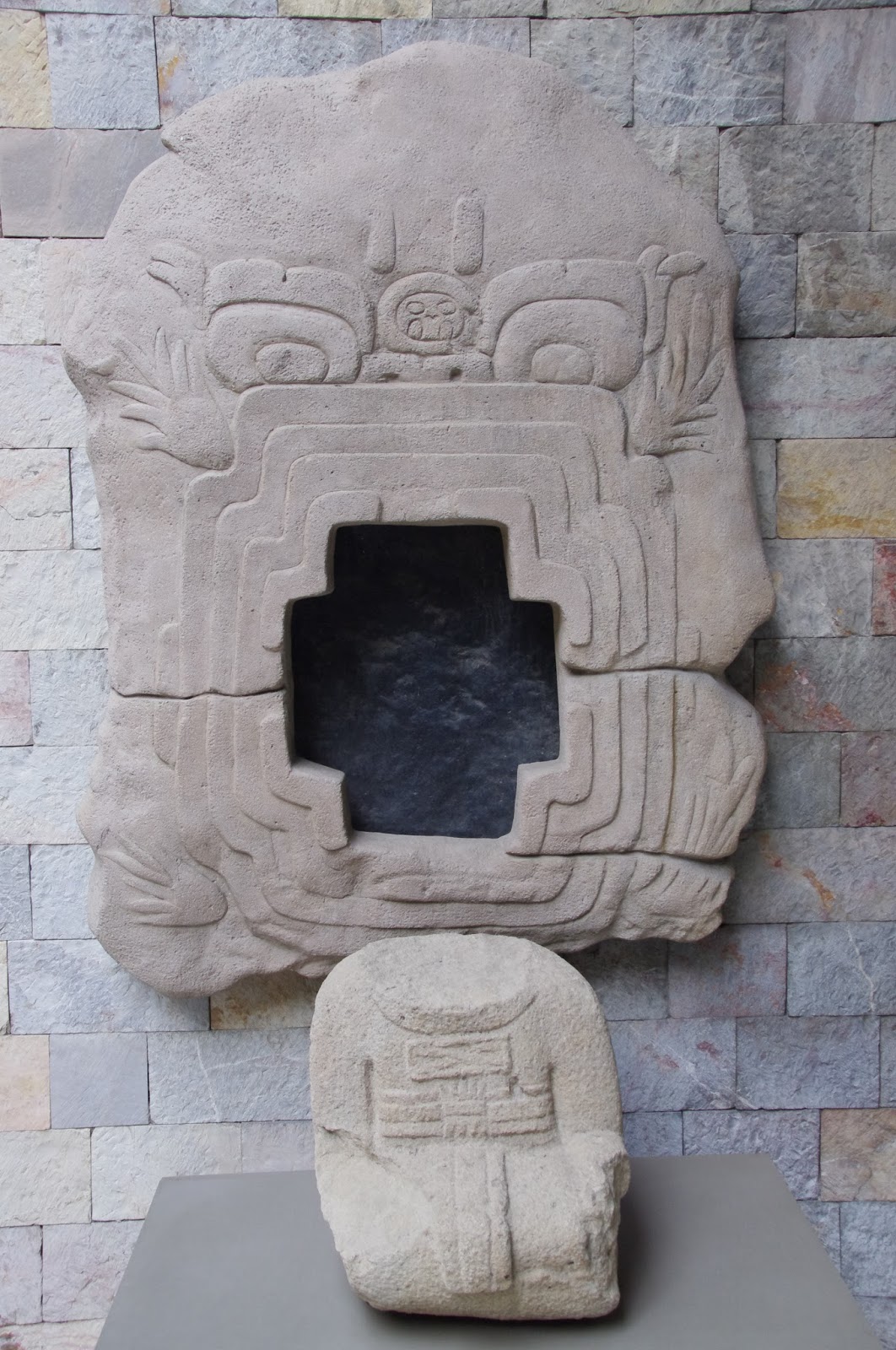
The same cave is represented on Monument no.9, this time from a frontal point of view. The cave has a quatrefoil opening, with a large hole in the middle corresponding to the cave entrance, above which are two eyes similar to the iconography of Monument no.1.
The same cave depicted on Monument No.1, now portrayed from a frontal point of view. Note the curious and artificial-looking quatrefoil opening in the middle, corresponding to the open mouth of the Earth monster (Cast in the National Museum of Anthropology, Mexico City) [Photo by Author]
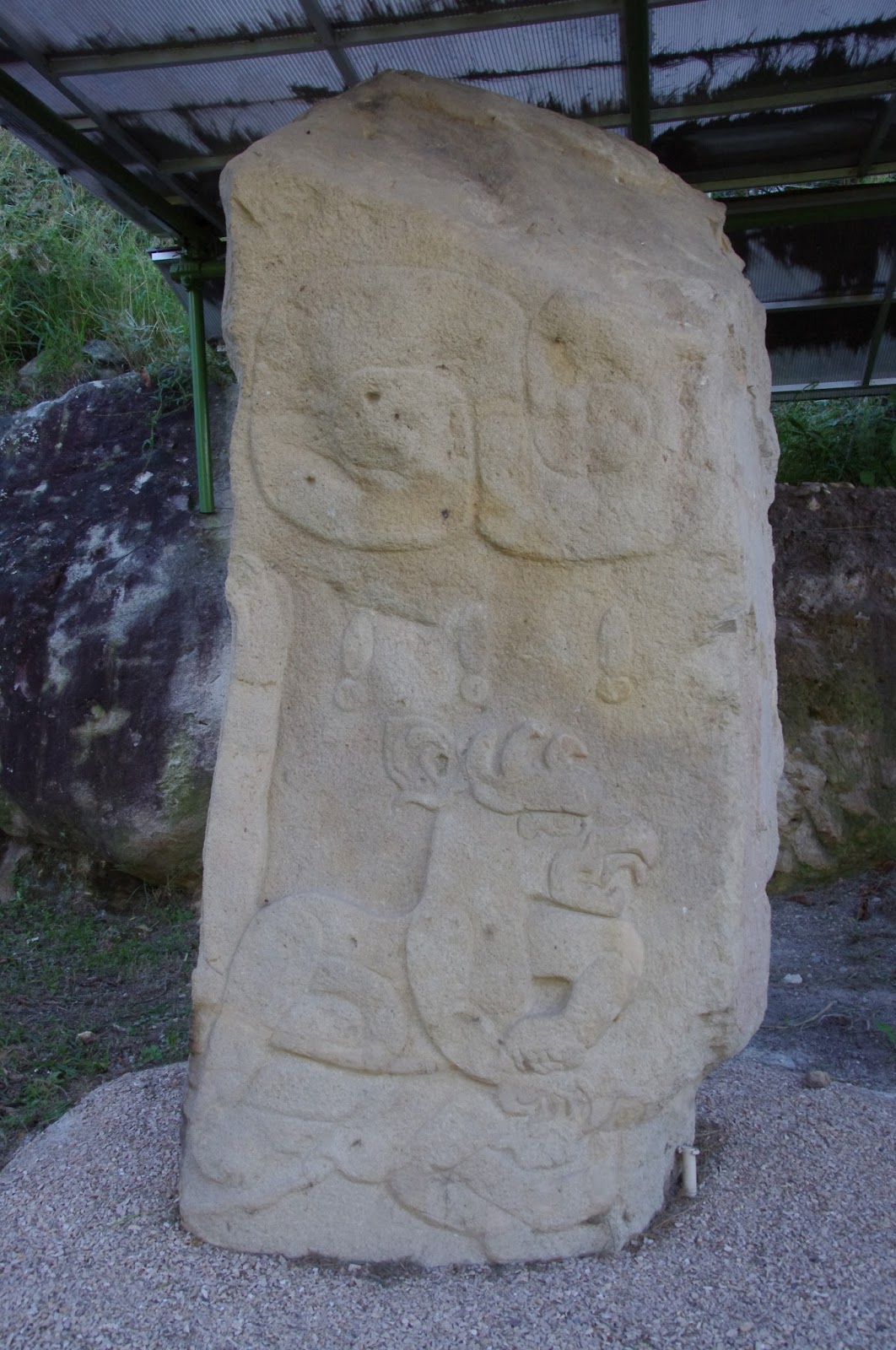
The figure of a Gryphon attacking a man on a loose stela found near the base of the Cerro Chalcatzingo. Note the exclamation signs (!) above the figure, probably representing large drops of rain. [Photo by Author] 
Another fragmentary monument (Monument no. 13) at the base of the hill shows, in the remaining portion, the same cave entrance with a figure, probably a priest, sitting inside it.  

Two more monuments among the over 40 present on the site are interesting for the purpose of our research. One, labelled Monument no. 21 depicts a woman in profile, standing next to a large rectangular object of unknown significance. The object appears to be a large pillar or obelisk, wrapped and covered in intricate designs. The object stands on a kind of platform, to which it seems to be attached. The platform encloses a square space with a diamond shape in the center and an opening in the middle. A similar scene is also portrayed on Monument no.32, this time representing a man mirroring the same gestures of the woman on Monument no. 21.

The monument marked no. 2, show a procession of elaborately clad personages wearing Olmec-style masks. Three figures are standing, brandishing what could be maces or torches, while a fourth figure is laying on the ground. This last figure is the most interesting, for it appears to be bearded and carries an elaborate headdress. It is unclear whether this is the depiction of a deceased or a bound prisoner.

A number of other carvings show serpents, jaguars attacking men (curiously depicted with a beak, which gives them the appearance of Gryphons, a subject otherwise unknown in Mesoamerican art), and an equally curious representation of a man wearing a helmet, who is either swimming or flying – attributes for which it has been aptly named “El Volador”.
The main pyramid-platform in the ceremonial center of Chalcatzingo, with the Cerro Delgado in the background. At its apex, the site had a population of between 500 and a thousand individuals [Photo by Author]
The spectacular landscape of Chalcatzingo, characterized by the remarkable alignment of three mountains, the Cerro Chalcatzingo (in the foreground, left), the Cerro Delgado and the almost perfectly pyramid-shaped Cerro del Chumil (in the background). The volcano Popocatepetl is hidden by clouds. [Photo by Author]

The siting of some of the bas-reliefs on large boulders apparently fallen from the cliff-face of the Cerro Chalcatzingo in the background [Photo by Author]

More of the curious rock carvings found on boulders around the base of the Cerro Chalcatzingo, believed to depict cosmogonical scenes related to the Creation of Man. [Photo by Author]
A secret cavern?

     For the extreme importance attributed to sacred caves in Chalcatzingo art, not a single significant cave is known in the Cerro Chalcatzingo or the neighboring Cerro Delgado. Both mountains represent singular geologic anomalies in an otherwise predominantly flat landscape. Their composition is a reddish porphyry, extremely hard and compact. Seen from a distance, together with the nearby Cerro del Chumil, they have the aspect of massive natural pyramids rising almost unnaturally from the plains of Morelos.

Because of the type of rock of which the Cerro Chalcatzingo and the nearby Cerro Delgado are composed, the presence of natural caves in their interior is extremely unlikely. It is, however, the peculiar way the cave entrance is depicted on the Chalcatzingo monuments and rock carvings that suggests we may not here be dealing with a natural cavern, but rather with an artificial tunnel or vault. The regular, quatrefoil shape of the cavern mouth, together with the other depictions of what appears to be a square or rectangular enclosure, are suggestive of an artificial space rather than a natural one.    
The impressive view from the summit of the Cerro Chalcatzingo, looking towards the Cerro Delgado (below) and the almost perfect pyramid shape of the Cerro del Chumil in the distance. Rising almost unnaturally from the level plain, these isolated peaks, which are moreover found in a perfect alignment to each other, represented places of natural sanctity for the early inhabitants of the Central Mexican highlands and might have inspired some of their earliest creation stories. [Photo by Author]
The figure of “El Rey” depicted on Monument no.1 sitting inside the cavern, further hints to the possibility that documents of some sort, together with “scrolls” and other sacred relics might have been buried inside the cavern. Additionally, the cave might have contained the burial of a very high-ranking individual of the Olmec or pre-Olmec elite.  

Another interesting parallel can be drawn between the carvings representing men being attacked and killed by jaguars, the references to rain in the form of clouds with rain drops and lightning, and the Mesoamerican creation myths. According to these early creation accounts, humanity had suffered at least four previous destructions, in which people were devoured by jaguars or drowned in a deluge. All of this seems to find a parallel in the strange rock-carvings of Chalcatzingo, which, according to several interpretations, might have been intended as an account of creation.

It is certainly suggestive to imagine the cave, surmounted by ominous clouds, as a sort of antediluvian shelter where documents and other artifacts were preserved from the coming deluge by a previous human race.
The strange, almost ´technological´ aspect of some of the objects displayed on the bas-reliefs, particularly the two bound pillars or obelisks portrayed on Monument no. 21 and on Monument no. 32, also seem to be related to the content of the cavern, particularly if the square enclosure depicted at the base of both monuments and is to be interpreted as a stylized cave or Earth monster.
Artist rendition of Monument No.1 of Chalcatzingo, known as "El Rey". One can appreciate both the cave (seen in profile) and the clouds pouring rain from above. 
The carvings on Monument No. 2, depicting a procession of masked men carrying maces or torches and a bearded individual lying on the ground.
Monument No. 21 of Chalcatzingo, depicting a woman touching a rectangular object of unknown significance, which could represent a bound pillar or stela, standing on top of a rectangular enclosure with an opening leading to a diamond-shape in the middle. 
Where, then, was this cavern located?
There are three possible locations for the cave entrance, two on the Cerro Chalcatzingo itself, and one on the nearby Cerro Delgado.  

The most obvious location would be on one side of the bas-relief known as “El Rey” or Monument no.1. There seem to be several large boulders on this spot covering what might be the entrance to a cavern, including parts of the bas-relief itself. The ground there is very humid, which might suggest the presence of a natural water source. There is moreover evidence of fairly recent excavations on the opposite side of the trench in which the bas-reliefs are located. If a cave existed at this spot, it has either collapsed or was covered by debris fallen from the cliff face in ancient times.   
The position of Monument No.1, known as "El Rey" (to the left of the picture), next to what could be the entrance of a collapsed cavern filled with large boulders. [Photo by Author]
A second location could be high up on the Cerro Chalcatzingo, where a rock ledge exists in the cliff face about one quarter of the distance to the summit. The position of this ledge on the almost vertical cliff-face and at an height of over 200 meters over the valley floor makes any exploration attempt almost impossible. The best piece of evidence for the existence of a cave or a yet undiscovered group of bas-reliefs on this spot is the fact that almost all of the rock carvings at the base of the Cerro Chalcatzingo are found on enormous rock boulders that must have detached from the mountain itself. Because of their position, it is very well possible that some of the bas-reliefs originally formed part of a continuous frieze located near the summit of the mountain, whose collapse left only the rock ledge which is still visible exposed.  
A view of the Cerro Delgado from the sunken patio in the main ceremonial area of Chalcatzingo. The profile of a monstruous face with two open eyes, nose and mouth can be made out on the rocks near the summit. [Photo by Author] 
A final possibility is that the cave entrance could be located not on the Cerro Chalcatzingo, but on the nearby Cerro Delgado. Pictures of the cliff face taken with the aid of a drone, do indeed reveal what might be cave openings very near the summit, in a location of almost impossible access. What is most intriguing about these possible cave openings is that they are strongly reminiscent, under certain light conditions, of the eyes and mouth of a giant monstrous face. This might explain the eyes placed around the mouth of the cave on the Chalcatzingo bas-reliefs. 
Could this be the reason why the site was also chosen by the Olmecs for realizing one of their most impressive settlements and artistic displays, so far from their cultural heartland on the Gulf Coast of Mexico? More research will be needed to confirm the existence of a cave entrance on the precise spot corresponding to the “mouth” of the Earth monster carved on the face of the Cerro Delgado.
A closer view of the Cerro Delgado from the air, near sunset. The oblique sunlight makes visible the entrance of some shallow caves near the summit of the mountain that curiously resemble the eyes depicted above the cave entrance on the two most famous Chalcatzingo monuments. If this interpretation is correct, the cave entrance may be found on the rock ledger where the "mouth" of the Earth monster is supposed to be. [Photo by Author] 
The discovery of this cavern might perhaps reveal more of the mysterious origins of the Olmec people and of Mesoamerican civilization as a legacy of the “Gods”.

A drone fly-over of the ancient site of Chalcatzingo and the nearby Cerro Delgado [Video by Author]: 

References:

[1] Chalcatzingo Archaeological Site – From Wikipedia:  https://en.wikipedia.org/wiki/Chalcatzingo
[2] David C. Grove, Ancient Chalcatzingo, University of Texas Press, Austin, 1987 – Online resource: http://www.famsi.org/research/grove/chalcatzingo/index.html
[3] Museum entry on Chalcatzingo, Morelos – National Museum of Anthropology,  Mexico City: http://www.mna.inah.gob.mx/coleccion/huellas-mna/anteriores/chalcatzingo-morelos.html