Showing posts with label Vesuvius. Show all posts

Friday, February 21, 2014

Pompeii 79 AD - Part IV

The Death of the Cities

A moonless night falls on the Forum of Pompeii, now empty after most visitors have left. [Photo by Author]
The eruption of Mount Vesuvius in 79 AD certainly had a quite extraordinary eyewitness. Pliny the Younger, then only 18 years old, described the tragedy unfolding from his villa in Misenum, on the opposite side of the bay of Naples, in two letters that he wrote to his friend and famous historian Cornelius Tacitus. 
At that time, Pliny's uncle (also called Pliny the Elder) was stationed in Misenum as the admiral of the Roman fleet, and could witness from that vantage point all the stages of the eruption.
We will borrow from his narrative to recall the final hours of Pompeii. 

August 24th, 79 AD – 1:00 pm

On 24 August, in the early afternoon, my mother drew his attention to a cloud of unusual size and appearance […]It was not clear at that distance from which mountain the cloud was rising (it was afterwards known to be Vesuvius); its general appearance can best be expressed as being like an umbrella pine, for it rose to a great height on a sort of trunk and then split off into branches, I imagine because it was thrust upwards by the first blast and then left unsupported as the pressure subsided, or else it was borne down by its own weight so that it spread out and gradually dispersed. In places it looked white, elsewhere blotched and dirty, according to the amount of soil and ashes it carried with it[1]

Around 1 pm, the pressure that had for centuries accumulated inside the Caldera of Mount Vesuvius finally burst out, causing the rock cap that for centuries had kept it contained inside the mountain to explode. The initial explosion produced a column of ash and pumice rising as high as 25 Km into the atmosphere, which started pouring on Pompeii to the Southeast in the form of a heavy ashfall. In this stage, the sky remained clear on Herculaneum, that was spared the ash and pumice rain as long as it remained upwind.
The pumice started very soon to accumulate in Pompeii, reaching in a span of hours a considerable thickness that started to threaten buildings and constructions under its weight. In this stage many people might have decided to leave the city, perhaps trying to reach the hills or the sea.  Mixed with the light pumice were however larger fragments of lava and molten rock that the explosion had ejected miles aways from the main crater. These fragments started falling with the strength of projectiles, piercing through the roofs of buildings and causing large fires to break out.  

Many of the buildings of the Forum were severely damaged or set on fire by volcanic bombs and lapilli. The continuous tremors would have caused cracks to open in the streets, that added to the danger of falling rocks and pumice. Many people remained trapped under building collapses or were killed by tiles and other heavy ornaments that fell from the roofs during the earthquake. [Photo by Author]
August 24th, 79 AD – 4:00 pm

As Pliny started receiving terrified reports of citizens trapped in their villas at the foot of the mountain, with no way of escape except by sea, his responsibilities as admiral of the Roman fleet took over his scientific curiosity:

He gave orders for the warships to be launched and went on board himself with the intention of bringing help to many more people besides Rectina, for this lovely stretch of coast was thickly populated. 
He hurried to the place which everyone else was hastily leaving, steering his course straight for the danger zone. He was entirely fearless, describing each new movement and phase of the portent to be noted down exactly as he observed them. Ashes were already falling, hotter and thicker as the ships drew near, followed by bits of pumice and blackened stones, charred and cracked by the flames: then suddenly they were in shallow water, and the shore was blocked by the debris from the mountain. [1]

Pliny made route to Stabiae, a wealthy resort to the South of Pompeii, where his friend Pomponianus had his villa. Pliny the Younger recounts that his uncle greeted Pomponianus, cheering and encouraging him; he then had a bath and dined, thinking that by his own conduct he could calm his friend’s fears. 

After the Eruption, Mount Vesuvius lost over half of its original elevation. Before the eruption, the slopes of Mount Vesuvius were entirely covered with vineyards. [Photo by Author] 
August 24th, 79 AD – 10:00 pm

As the night fell, “broad sheets of fire and leaping flames blazed at several points” on Mount Vesuvius. In the meanwhile, the falling ash and pumice had piled up already to a considerable height, almost filling the courtyard of the house where Pliny was sleeping.

By this time the courtyard giving access to his room was full of ashes mixed with pumice stones, so that its level had risen, and if he had stayed in the room any longer he would never have got out. He was wakened, came out and joined Pomponianus and the rest of the household who had sat up all night.
They debated whether to stay indoors or take their chance in the open, for the buildings were now shaking with violent shocks, and seemed to be swaying to and fro as if they were torn from their foundations. Outside, on the other hand, there was the danger of failing pumice stones, even though these were light and porous; however, after comparing the risks they chose the latter. In my uncle's case one reason outweighed the other, but for the others it was a choice of fears. As a protection against falling objects they put pillows on their heads tied down with cloths.” [1]

August 24th, 79 AD – Midnight

While Pliny was sleeping unaware of the terrible fate that doomed on the city, the great cloud of ash and pumice that had risen as high as 30 Km into the atmosphere, collapsed spectacularly causing massive pyroclastic surges that headed straight to Herculaneum. The surges instantly killed everyone on their path, including those who had taken shelter in the boathouses and on the beach and burying Herculaneum under 23 meters of volcanic material. Miraculously, a second surge headed to Pompeii stopped a few meters outside of the Herculaneum gate, thus sparing the city and those who had found refuge within its walls.

August 25th, 79 AD – 6:00 am

That day, the Sun would not rise on Pompeii and the other cities on the Southern Coast of the Bay of Naples. As Pliny recounts “Elsewhere there was daylight by this time, but they were still in darkness, blacker and denser than any ordinary night, which they relieved by lighting torches and various kinds of lamp”. As the elder scientist went on to investigate the possibility of an escape by sea, poisonous gases released by the eruption caused him to fall to the ground, where his body was later found untouched by the rescuers.

Then the flames and smell of sulfur which gave warning of the approaching fire drove the others to take flight and roused him to stand up. He stood leaning on two slaves and then suddenly collapsed, I imagine because the dense, fumes choked his breathing by blocking his windpipe which was constitutionally weak and narrow and often inflamed. When daylight returned on the 26th - two days after the last day he had been seen - his body was found intact and uninjured, still fully clothed and looking more like sleep than death.[1]

At that point, many of the buildings in Pompeii that had not collapsed under the weight of the thick ash and pumice were on fire or shaking because of the continuous tremors.

A number of bodies were found in Pompeii inside the Macellum, a building that served as the main covered marketplace of the City, where goods were traded and sold. As these were some of the only few bodies found around the Forum, it is unclear whether they had been killed by the pyroclastic surge or by the building collapse. [Photo by Author]
August 25th, 79 AD – 8:00 am

A short couple of hours after dawn, the Mountain exploded with terrifying power, causing massive surges to cover the cities of Pompeii, Stabiae and Oplontis that had until then been spared by the pyroclastic flows. Travelling at over 100 miles per hour, this last pyroclastic surge left no escape to those who had fled to the hills or had decided to stay inside their houses in Pompeii. The conflagration also caused a small tsunami to hit the Bay of Naples, as testified by the retreat of the sea that Pliny himself witnessed at Misenum.

The surge then crossed the Bay of Naples as a fiery cloud, reaching to Misenum where Pliny the Younger was witnessing in horror the final stages of the eruption. This last passage of Pliny is worth quoting in its entirety:

A dense black cloud was coming up behind us, spreading over the earth like a flood. ‘Let us leave the road while we can still see,'I said,'or we shall be knocked down and trampled underfoot in the dark by the crowd behind. ‘We had scarcely sat down to rest when darkness fell, not the dark of a moonless or cloudy night, but as if the lamp had been put out in a closed room.
You could hear the shrieks of women, the wailing of infants, and the shouting of men; some were calling their parents, others their children or their wives, trying to recognize them by their voices. People bewailed their own fate or that of their relatives, and there were some who prayed for death in their terror of dying. Many besought the aid of the gods, but still more imagined there were no gods left, and that the universe was plunged into eternal darkness for evermore.
There were people, too, who added to the real perils by inventing fictitious dangers: some reported that part of Misenum had collapsed or another part was on fire, and though their tales were false they found others to believe them. A gleam of light returned, but we took this to be a warning of the approaching flames rather than daylight. However, the flames remained some distance off; then darkness came on once more and ashes began to fall again, this time in heavy showers. We rose from time to time and shook them off, otherwise we should have been buried and crushed beneath their weight. I could boast that not a groan or cry of fear escaped me in these perils, but I admit that I derived some poor consolation in my mortal lot from the belief that the whole world was dying with me and I with it. [1]

After the eruption subsided, what was left was a devastated and almost lunar landscape. The cities of Pompeii, Herculaneum, Stabiae and Oplontis, together with countless villages on the slopes of Mount Vesuvius, had been completely destroyed and buried under as much as 23 meters of volcanic ash. In Pompeii, ash and pumice had piled up as high as 5 meters, covering almost every building but the largest public structures. Where Mount Vesuvius once stood, was now a huge crater created by the collapse of the magma chamber. Thousands had been killed in Pompeii and Herculaneum, and many more had been left without a house or shelter.     

This man was found crouching in a corner near the fullery of Stephanus, he might have been desperately trying to cover his mouth as the asphyxiating gases released by the eruption had already filled the streets. [Photo by Author]
A dog, still wearing a collar and tied to its chain, was also among the victims of the final surge that invested Pompeii. [Photo by Author]
A number of people had taken shelter in a garden near one of the gates in the walls of Pompeii, perhaps waiting for someone to come to their rescue. They were probably sleeping when the surge caught them unaware. [Photo by Author]
Among the bodies found in the Garden of the Fugitives, as it came to be known after it was discovered in the '60s, was that of a well built man holding the hand of a woman in one last, eternal embrace. [Photo by Author]
A rescue was organized, and the Emperor himself appointed two ex-consuls to coordinate the relief effort. But the destruction was just too great. Life resumed along the coast of the Bay of Naples, as many towns were reconstructed and the extensive damage caused by the eruption in Naples and other cities as far as 50 miles from Mount Vesuvius was restored.
Pompeii and Herculaneum, however, would lay forgotten for almost 1,500 years, until workers digging for an aqueduct in Pompeii unearthed some walls and frescoes. It was not until the Borbonic excavations of the 18th and 19th Century that a relevant portion of Pompeii could see the light again, and even then it took many years before excavators could positively confirm that the ruins they had been painstakingly uncovering were indeed those of Pompeii.

Here is a very beautiful animation from the Melbourne Museum of the last hours of Pompeii: 


References
[1] "The Destruction of Pompeii, 79 AD," EyeWitness to History, www.eyewitnesstohistory.com (1999). 

Wednesday, February 19, 2014

Pompeii 79 AD - Part III

The Necropoleis and Walls of Pompeii

The large Necropolis outside of Porta Ercolano contains hundreds of tombs and is the largest of those unearthed in Pompeii. Along the Avenue of Tombs opened the entranceways to wealthy suburban villas flanked by stores and taverns catering to the many travellers who entered Pompeii from the South. [Photo by Author]
The avenue that from Porta Ercolano leads to the Villa of the Mysteries may be rightfully called a veritable Avenue of Tombs [Via dei Sepolcri]. On both sides outside the gate, the consular road is flanked by tombs and funerary monuments, as it was customary outside of Roman cities (Roman law did not allow the burial of the dead within the city walls, therefore cemeteries had to be built outside, with the largest and richest tombs located in prominent position along the main ways leading in and out of town).  The Via dei Sepolcri is perhaps the most famous of the cemeteries that are found outside the walls of Pompeii. The necropolis of Porta Nola, Porta Nocera and Porta Vesuvio are also notable for their carefully arranged funerary monuments. The tombs are an authentic “Who was Who?” of ancient Pompeii.  Here is found the tomb of Naevoleia Tyche and his husband, Caius Munatius Faustus, a priest of the deified Emperor Augustus (Augustalis), who had likely made his fortune through commerce as suggested by the beautiful bas-relief of a trading vessel that decorates the side of the monument. Here are also the tombs of Umbricius Scaurus, who organized gladiatorial games in the amphitheater; Marcus Porcius, who dedicated the Odeion (Theatrum Tectum) and the amphitheater (Spectacula); and the priestess Mammia, to whom an inscription attributes the dedication of the temple of Augustus in the Forum. Outside Porta Nocera we can find the tomb of the Priestess Eumachia, undoubtedly one of the wealthiest and most powerful women in Pompeii, who dedicated the building named after her in the Forum, in addition to several statues of the Emperors Tiberius and Augustus. An interesting inscription not far from her tomb, on what must have been a major highway leading into town, sheds an interesting light into some very ancient Italian malpractices. The inscription was commissioned by a certain, Titus Suedius Clemens, a tribune, and reads “EX AUCTORITATE IMP CAESARIS VESPASIANI AVG LOCA PVBLICA, A PRIVATIS POSSESSA T SVEDIUS CLEMENS TRIBVNVS CAVSIS COGNITIS ET MENSVRIS FACTIS REI PUBLICAE POMPEIANORVM RESTITVIT”, meaning “By virtue of authority conferred upon him by the Emperor Vespasian Caesar Augustus, Titus Suedius Clemens, tribune, having investigated the facts and taken measurements, restored to the citizens of Pompeii public places illegally appropriated by private persons”.  Already in 79 AD Italy private abuse was quite widespread if it took the authority of the Emperor to restore public ownership of communal land.

The avenue of tombs was lined with the sepluchers of Pompeii's notables and famous. This now dilapidated tomb once belonged to the magistrate Umbricius Scaurus, and still retained much of the original stuccoed decoration portraying hunting games and gladiator fights at the time of its discovery in the 19th Century. [Photo by Author]
Some of the tombs were of truly monumental proportions and often contained the remains of entire families across many generations. [Photo by Author]
Many of the tombs were richly ornamented with stuccoes and paintings. Some also contained benches for the rest of travellers and wayfarers. [Photo by Author]
Given its proximity to Mount Vesuvius, the Necropolis of Porta Ercolano suffered the full intensity of the pyroclastic flows ejected by the volcano. [Photo by Author]
One of the most ornamented tomb stones is that belonging to Naevoleia Tyche, undoubtedly one of the wealthiest and most powerful women in Pompeii. [Photo by Author]
Not less interesting, outside of Porta Vesuvio, is the Tomb of Vestorius Priscus. The man, who died at the age of 22, held the office of Aedile, which was a minor city magistrate in charge of the construction and maintenance of public buildings. Among the several painted scenes that decorate the tomb, three are particularly notable. The first one shows the deceased, Vestorius Priscus, in his office of magistrate facing an audience. The second shows a remarkable still life of silver vessels, carefully laid on a table. These include beautiful inlaid cups, plates, saucers and spoons. It is the third scene, however, which is perhaps the most interesting: it shows a pair of fighting gladiators, wearing the weapons of the thraex and the hoplomachus. The winner is standing, while his opponent lies to the ground still holding to his shield. Quite interestingly, both gladiators seem to be wearing a very fine tunic made of a translucent material similar to silk. The fresco is thought to memorialize a munus offered by Vestorius Priscus in the amphitheater of Pompeii when he was an Aedile. 

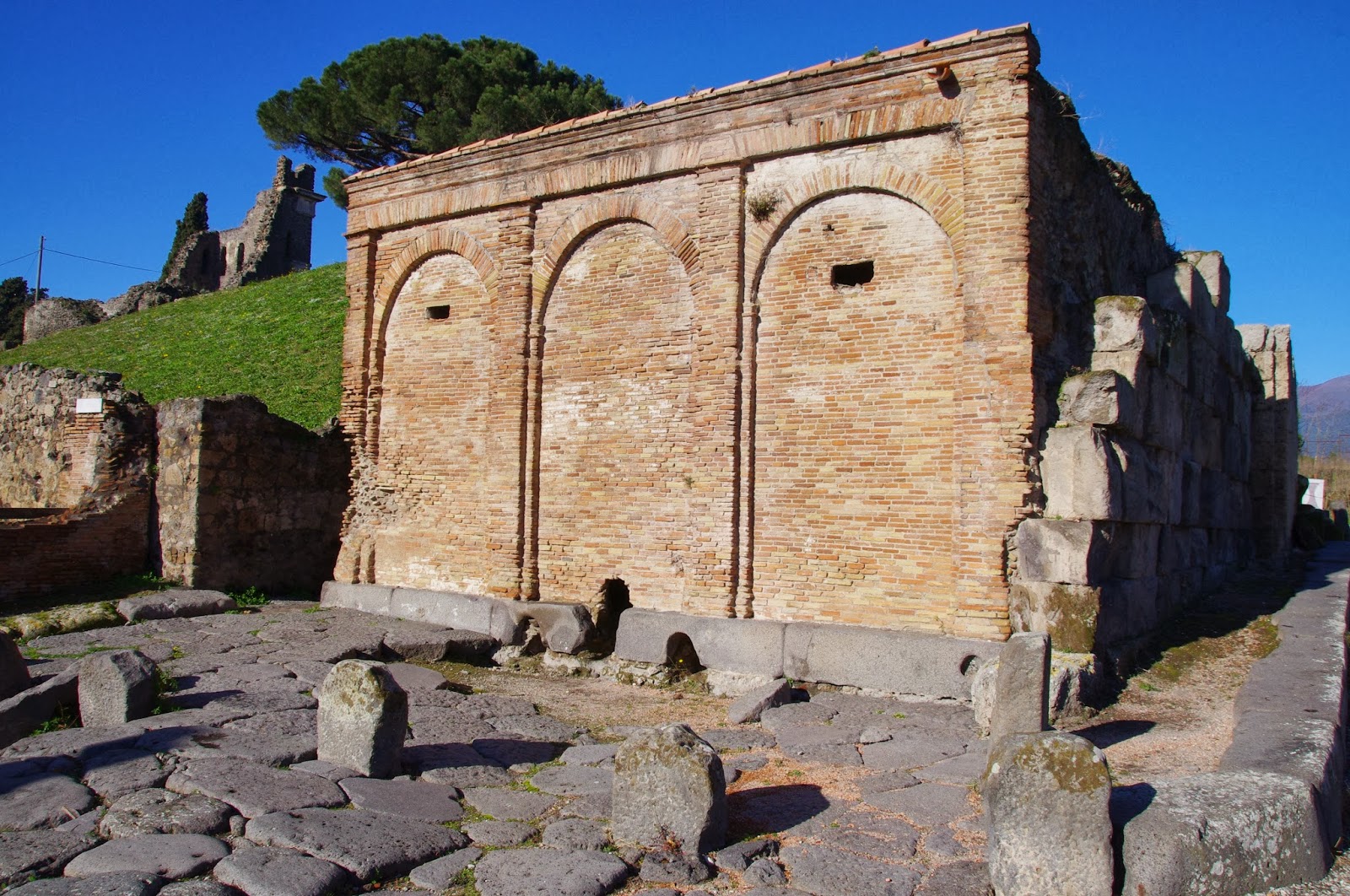
One approaches the tomb of Vestorius Priscus through the Vesuvius Gate. This vaulted structure right next to the gate once served as the main water distribution terminal for the acqueduct that served the city of Pompeii [Castellum Acquae]. Lead or terracotta pipes carried fresh water to fountains, baths and private houses throughout the city. [Photo by Author]

Inside the tomb of Vestorius Priscus are beautiful scenes depicting a gladiator fight between a Thraex (to the left) and and Oplomachus (to the the right). The scene is particularly interesting for the vivid depiction of the armor and weapons of the two gladiators, as well as for the very strange silk tunic that both seem to be wearing. [Photo by Author]
This set of silverware, so remarkably similar to roman silverware of the Ist Century AD found in Museums throughout the world, and especially to the famous treasure of Boscoreale, signalled the wealth and prestige of the deceased, and wouldn't have disfigured even on a modern table. [Photo by Author]

The Walls of Pompeii are perhaps its most overlooked monument. The walls are over 3 Km in length, pierced by 7 gates and protected by towers, of which the Tower of Mercury is perhaps the most famous. The walls bear all the signs of a protracted siege by the troops of Sulla during the Roman civil war. The walls, whose construction probably dates to the Samnitic period, are built of large volcanic tufa blocks, and were later elevated with the addition of towers when Pompeii became a Roman colony. The surviving towers were as much as 3-Storeys high, with arched windows for artillery. Several graffiti and quarry marks can still be found on many of the stones that compose the walls. 


The tower of Mercury is the most famous of the several towers that once guarded the walls of Pompeii. It is 3 storeys high and connected to a high tufa wall dating to the early Republican period and which also suffered a siege by Sulla during the Roman civil war. [Photo by Author)
Porta Marina, at night. Of all the gates of Pompeii, this was the closest to the sea. The port of the city may still lie buried a short distance from here, even if its exact location has so far escaped archaeologists. Recent excavations have uncovered large thermal structures (so called Terme Suburbane), a temple of Venus, residential areas and a villa that supposedly belonged to the Imperial family. [Photo by Author] 

Wednesday, February 12, 2014

Pompeii 79 AD - The Ghosts of Vesuvius

The Mystery of a City Frozen in Time

A victim and her killer. The forum of Pompeii, against the background of Mount Vesuvius, a short 10 Km away, on a clear day. [Photo by Author]
          Pompeii is a place like no other in the world. It provides the unique chance to see and walk around the streets of a city of the ancient world exactly as an ancient Roman would have seen it. It provides an exceptional glimpse into the daily life of an ordinary, thriving Roman town, frozen in time in that terrible day of August 79 AD. Under its tomb of volcanic ash, Pompeii never suffered the fate of much of the Roman West: it suffered no decadence, no invasions; no barbarians ever walked its streets with plunder.

Pompeii also strikes us as place far from our idealized view of classical antiquity, it is striking in its modernity and normality. Strange enough for a dead city, it is a place that still breaths with the lives of countless ordinary men and women who perished in the great catastrophe of 79 AD. People whose names we know from inscriptions found in the very houses where they lived as well as in the monuments and buildings of a city that is only exceptional for its fate, but would have looked plainly ordinary or even dull to any 1st Century Roman. The people and lives immortalized by the eruption are not those of great Emperors and military leaders, but of ordinary citizens, which surprise us with the full range of their professions: bakers, storekeepers, artisans and painters, money lenders, soldiers, priests and magistrates.  

A pedestrian crosswalk on the Via Stabiana, near its intersection with Via dell'Abbondanza. [Photo by Author]
Yet the art and lavish luxury of Pompeii surprises and fascinates us after almost two thousand years – we can only imagine how shocking this must have been to XVIII and XIX Century travelers whose cities and households would have appalled in front of the wealth of a city destroyed by the fury of Vesuvius. At a time when a vast majority of European population still lived in poverty in cities that lacked even the most basic services and infrastructure, how breathtaking must have been the sight of an entire city buried under the earth that once enjoyed public baths and fountains, running water, metal plumbing and even heating pipes for the winter months. Even today Pompeii is surprising for its modernity, thinking of its people already plagued by traffic to the point of creating dedicated pedestrian zones, the walls littered with electoral posters and advertising, the heated pools and baths, and the stores filled with goods from all corners of the Empire. Yet what is most striking to us is the art of Pompeii. Not a wall or surface was spared some form of decoration, from the excellent frescoes inspired by Greek and Hellenistic painting to the delicate stuccoed ceilings and mosaic floors. In some cases its art is so excellent as to be unrivalled among all surviving testimonies of the ancient or the modern world. In other cases the art is much less refined, to appeal to a more popular taste, but always skillful and mature.  As we move between the rooms of the mansions that once belonged to the Pompeian elite, the feeling is that of walking the alleys of a museum or an art gallery, yet the skeletons and body casts are always there to remind us that real people once lived there. Because Pompeii strikes us with its human tragedy nearly as much as it does with its art. Everywhere are the reminders of the immense disaster that struck the city. Preserved in casts and molds are the shapes of the objects of their everyday life, ordinary pieces of furniture, window blinds, doors and frames, as well as the bodies of the people who perished on that fiery night of 79 AD. We may attempt to reconstruct some of their stories from fragments frozen in time: those who were caught by the eruption inside their homes, where they had taken shelter, or in the streets and alleys, killed by the deadly pyroclastic flow, often holding to their children or their beloved ones for fear of losing them in the dark.   

These are just fragments from a city frozen in time...

The Forum

The Capitolium was the main sacred building in Pompeii, facing the forum against the background of Mount Vesuvius. It was a symbol of the city's prestige and status as a Roman Municipium. [Photo by Author]
The forum was flanked by beautiful marble colonnades on three sides. [Photo by Author]
The many platforms and pedestals that can be seen in the Forum square once hosted statues of the City's notables and wealthiest citizens. Because the Forum was under renovation at the time of the eruption, it is possible that the statues had been removed and stored in some safe place. [Photo by Author]
The forum was paved with fine marble slabs and flanked by imposing colonnades and public buildings that made it the commercial and administrative heart of the city
Access to the Forum was by means of a triumphal archway. Its marble casing was either unfinished at the time of the eruption, or was most likely the victim of looting in the decades that followed the disaster, when many of the major building still surfaced from the ash that covered the rest of the city. [Photo by Author]
          Almost every visit to Pompeii starts from the Forum, the main square and the very heart of the city life. The Forum square must have been beautiful, with its fine paving and exquisite marble colonnades. The Forum would have been bustling with activity, and a major renovation was underway after the devastating earthquake that had struck the city only a few years earlier, in 64 AD. Undoubtedly many people must have fled the city after the continuous earthquakes that had preceded the eruption, but many more had decided to stay and were actively engaged in embellishing their town with new buildings and decorations. New statues were being erected in the Forum, and the great basilica and the Capitolium had been freshly renovated. The precious marble and bronze undoubtedly attracted looters even in the immediate aftermath of the eruption, as certainly the highest parts of the buildings would have emerged from the layer of ash – as much as 5 to 7 meters thick – that had covered much of the city at this point. So it happened that many of the marble columns and even some of the paving slabs were plundered and carried away. A building to the right of the Capitolium served as the market for Pompeii. There several bodies were found trapped under the thick ash and pumice.  

The Baths of the Forum

The stuccoed decoration inside the Baths of the Forum is stunning for its remarkable preservation and the quality of its execution. [Photo by Author]
          This elegant thermal complex was built immediately behind the Capitolium, and occupied a whole block with its exquisite vaulted rooms and open courtyard. The apodyterium and the frigidarium are stunning with their stuccoed decoration and the marble basins, where one can still perceive a trace of the original coloring of the walls and ceiling. This is only one of several thermal complexes discovered at Pompeii, both public and private, that also include the Stabian Baths, the Sub-urban Baths near Porta Marina and the Central Baths. All baths had large steam rooms, cold and heated pools, as well as outside courtyards for physical exercises. However, nowhere is the decoration more exquisite that in the Forum Baths.

The “Great Theater” and the “Odeion”

The Great Theater still preserves some of the original marble seating, though much has been lost. [Photo by Author]
The balustrade of the Odeion was finely decorated. The scenae frons and perhaps some of the seating were originally covered in marble. [Photo by Author]
The Odeion, also called Theatrum Tectum [i.e. Covered Theatre], was a smaller building, suitable for more intimate performances and perhaps also used as a meeting hall for the city council [Photo by Author]
          Pompeii also possessed its own theater district. It contained a large theatre with a capacity of as much as 5,000 seats and a smaller theater or Odeion (also called a Theatrum Tectum, that is a covered theatre), which also likely served as the city’s bouleouterion, or a place of assembly for the city’s senate. Even though both theatres have been stripped of their original marble seating, columns and decoration, one can still appreciate the disposition of the seats, part of the scaenae frons and even the supports for the masts that once held the velarium that once protected the spectators from rain or the heat of the day. Of the two, the Odeion is the most beautifully preserved, with its colored marble floor and the atlas statues on the balustrade.

The Temple of Isis

The dedicatory inscription of the Temple of Isis, celebrating the temple's restoration after the devastating earthquake of 64 AD. [Photo by Author]
The temple of Isis was built in Roman style, with few imported Egyptian elements that, together with the frescoes, would have conferred it a rather exotic appearence. [Photo by Author]
          Immediately behind the Great Theater was the temple of Isis, undoubtedly one of the most important sacred structures in the whole city and certainly one of the oldest of its kind in the European Continent. Not much remains of the beautiful frescoes (many of which are now in the National Museum in Naples) that provoked the admiration of its first excavators. Yet what is left of the stuccoed decoration is enough to imagine how this shrine would have looked like in its heyday, with robed priests dressed in the Egyptian manner walking its steps and burning incense in front of the statues of the Goddess and the sacred barge. A curious inscription on the entranceway celebrates the restoration of this temple after the earthquake of 64 AD by a certain Popidius Celsinus. “AEDEM ISIDIS TERRAEMOTV CONLAPSAM A FVNDAMENTO P.S. RESTITVIT”, as reads the inscription, whose original is now in the Museum of Naples.

The Amphitheater

The Amphitheater of Pompeii is arguably among the best preserved in the Roman World, and also among the oldest surviving, dating back to the Republican period. [Photo by Author]


Circulation inside and outside the amphitheater was ensured by stairways and vaults. The only access to the seating sectors of the cavea was from the outside. [Photo by Author]
Balustrades separated the different sectors of the amphitheater to reflect social status and prestige. [Photo by Author]

          Together with the Forum and the Capitolium, the Amphitheater was undoubtedly one of the most distinctive features of a Roman town. The Amphitheater of Pompeii, one of the earliest in Campania, still preserves much of its original seating and balustrades intact. However, nothing remains of the beautiful frescoes that once decorated the walls of the Podium, depicting gladiatorial fights and hunting scenes: they survived the eruption and the passing of almost 18 Centuries, but finally perished to a single night of frost shortly after careful drawings were taken of them. The amphitheater has no substructure and spectators could only access their seats through stairs located on the outside. However, a service corridor exists around the arena. Both gates, the porta triumphalis and the porta libitinensis are beautifully preserved: from there gladiators entered and exited the arena. In Pompeii was found one of the most extensive collections of gladiatorial weapons and armor, including gladiator helms, shields, daggers and arm and tight protections. The passion and interest for the games was certainly widespread at Pompeii as in much of the Roman World, as it is abundantly testified by the wealth of graffiti depicting the champions of the arena which are found everywhere in Pompeii. The amphitheater was also the stage of a bloody riot in 53 AD between the citizens of Pompeii and nearby Nuceria, which left countless dead and caused the Emperor Nero to order the closure of the Pompeian amphitheater for 10 years as a punishment to the city. This infamous riot is also portrait in a famous fresco from the house of the Gladiator Actius Anicetus (now in the National Museum in Naples), with all the freshness of Roman popular art. Several were also the magistrates who organized gladiatorial games to win the public favor for an election, as is testified by the now lost stuccoed reliefs that once decorated the tomb of Umbricius Scaurus – of which only the XIX Century drawings remain - and by the almost life-size gladiator paintings in the beautifully preserved tomb of Vestorius Priscus outside of the Vesuvius Gate.

A fresco with gladiator fight between two Thraces from the tomb of Vestorius Priscus. [Photo by Author]
Pompeii also certainly had a ludus, which is a gladiator school, and gladiatorial barracks, where a majority of gladiator weapons and armor were found. A House in the Northern portion of the city (so called Caserma dei Gladiatori) was certainly converted, perhaps after the earthquake of 64 AD, into such a ludus, a fact which is confirmed by the several hunting scenes decorating the courtyard balustrade and by the small rooms to the sides of it, which were converted into cubicles or living quarters for the gladiators of the school.