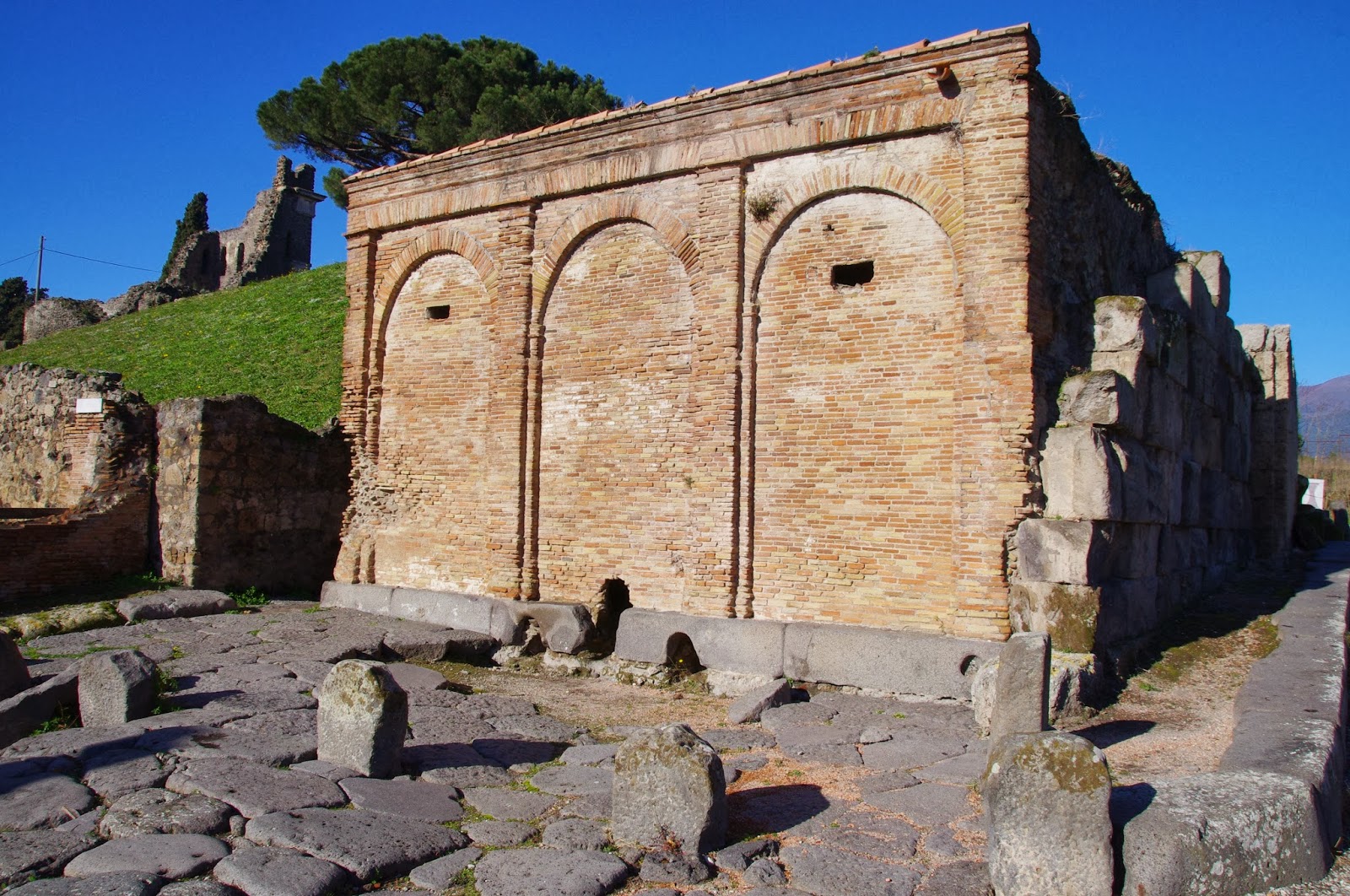
The Houses of Pompeii
The houses of Pompeii are an excellent mirror
of Roman society. As any modern city, Pompeii had its good and its bad
neighborhoods too. Houses range therefore from wealthy mansions encompassing
porticoes (peristylium) and gardens
to more modest flats inside large apartment buildings (insulae), often right above rows of stores or taverns. The houses of
Pompeii were clearly influenced by the austere samnite style, yet it is
surprising to find that many of the wealthier Pompeian houses were already old,
sometimes by as much as two or three hundred years at the time of the eruption
that finally buried them. This is especially true for the houses that were
decorated in the so called “first
Pompeian Style”, that is a purely geometric decoration that often mimics
marble or some other expensive stone. This austere geometric décor was probably
considered a reflection of the severitas
(severity) and gravitas (gravity) of
the owners, both quintessential Roman virtues that, largely forgotten in the latest years of the Roman Republic, would again be championed by Augustus himself during the years of
his Principate (27 BC – 14 AD).
 |
| A view of some of the residential areas of Pompeii along the Avenue of Theaters, against the background of Mount Vesuvius. [Photo by Author] |
The grandiose
House of the Faun must have already looked like a museum even to a
Roman visitor of the I Century AD. It
occupies a whole block in the most prestigious part of town, right north of the
Forum, and is built on a scale that, perhaps deliberately, echoes that of
Hellenistic palaces. Here the massive stone façade crowned by elegant
Corinthian capitals gives way to a purely geometrical decoration in the finest
first Pompeian style. The guests would have been greeted by a dancing Faun on a
fountain, right in the
atrium of the
house. And the floor mosaics were exquisite too. Here is found what is perhaps
the finest surviving mosaic from the ancient world, the so called “Alexander
Mosaic”. Measuring almost 6 meters by 3, it consists of well over 2 million
tiny
tesserae, and depicts, in a
grandiose composition, the victory of Alexander the Great over Darius at Issus
(or, according to other sources, Gaugamela). The mosaic is likely a copy from a
now lost Hellenistic painting commissioned at the Court of Macedon in the III
Century BC, yet the copy is of such fine quality that one can hardly regret the
loss of the original. All the other mosaics found in the house of the Faun, all
of the most excellent quality, fill almost an entire room of the National
Museum of Naples, together with the absolute masterpiece, the Alexander Mosaic itself.
It creates an even greater impression to think that all these mosaics were
already over two hundred years old at the time of the eruption and must have
been already regarded as pricey antiques.
The
ancients had their own antiquity too, after all. Beyond the
atrium,
the house had a large
peristylium, with what was perhaps intended as a
miniature theatre for private performances. In spite of the remarkable wealth
and luxury of the house of the Faun, its owner remains unknown, but a Samnite
general has been suggested as its first tenant.
 |
| The Alexander Mosaic from the House of the Faun in Pompeii is believed to be a copy of a (now lost) 4th Century BC hellenistic original by the painter Philoxenes of Eretria. The clash of the Macedonian and the Persian armies is depected with astonishing realism and attention to detail. This mosaic, which was already two hundred years old at the time of the eruption that buried it in 79 AD, is a testimony to the exquisite taste of the fashionable owners of this grand Pompeian mansion. [Photo by Author] |
 |
| The portrait of Darius contemplating the route of his army while desperately commanding his charioteer to flee the battle is among the most dramatic of the whole battle scene. [Photo by Author] |
 |
| The portrait of Alexander the Great, wearing the Gorgon breastplate on his horse Bucephalus and focusing his gaze on a fleeing Darius is believed to be one of the most faithful portraits of the great conqueror. [Photo by Author] |
 |
| A beautiful false architecture in the finest first Pompeian style decorates the entranceway into the House of the Faun. Right inside the Atrium, the guests would have been greeted by the bronze statue of a dancing Faun. [Photo by Author] |
The House
of the Ceii, in the Southern part of the city, is similarly austere and
certainly commanded great status and prestige. Its exterior façade is in the
purest first style, with severe square capitals framing the doorway (it is
interesting, though, that not even the walls of this venerable and austere
mansions were spared from ancient graffiti and electoral posters painted in red
ochre). The interior of this house, however, takes us amidst the more recent
second Pompeian style, with the austere geometric decoration giving way to
beautiful painted landscapes and the great hunting scene for which this house
is most famous. The small and intimate atrium
of this house, with its plastered columns painted in a delicate yellow tone, makes this
house one of the finest in Pompeii.
 |
| The severe exterior of the House of the Ceii signalled the prestige of its owners. Not even its imposing facade was however spared from graffiti and electoral posters. [Photo by Author] |
 |
| The Atrium of the House of the Ceii is remarkably preserved, with beautiful plastered columns and a fine impluvium. [Photo by Author] |
 |
| The House of the Ceii is most famous for the beautiful hunting scenes that decorate the Viridarium, in the backyard of the House. The scene, set against an exotic background, may have been inspired by hunting games in the Amphitheater (Venationes), with a lion chasing a bull and other animals in the upper band. [Photo by Author] |
 |
| To the side of the great hunting fresco, a rarefied nilotic lanscape with temples and fantastic architectures must have given the garden a distinct exotic feel. [Photo by Author] |
The House
of Menander is only a short walk from this last one, right across the
street, but belonging to a much wealthier neighbor. The paintings of the atrium are unfortunately very ruined, but
the rooms around the peristylium and the beautiful inner courtyard are a real
surprise. Here is a beautiful painting of the poet Menander (hence the name of
the house), together with other mythological frescoes of Anteon devoured by
hounds and a remarkable lararium. The
house also has beautiful mosaics, such us a very fine Nilotic scene with
pygmies. But the real hidden gem is a small private bathroom, still complete
with its frescoes, stuccoed ceilings and mosaic floors. This little room feels
so private and secluded that one would be tempted to knock at the door before
entering.
 |
| The House of Menander owes its name to a famous fresco of the poet Menander that decorates a recess of the Peristilium of the house. [Photo by Author] |
 |
| The Peristilium of the House of Menander is among the finest and best preserved in Pompeii. Even the plants and the vegetal ornamentation have been carefully reconstructed after remains of wood and pollen recovered after the archaeological excavations. [Photo by Author] |
 |
| This small bathroom, with its fine frescoes, mosaic floors and stuccoed decoration is one of the most intimate and private rooms of this large, stately mansion. [Photo by Author] |
The House
of the Chaste Lovers, along the Via
dell’Abbondanza, is a true sneak peek into the everyday life of an ordinary
Roman household. The rather unassuming
exterior gives way to a sprawling mansion, which also contains stores facing
the main road and a baker’s shop. The house, that had been clearly restored and
freshly repainted after the devastating earthquake of 64 AD, is a wonder in the
third Pompeian style. The painted architectures are almost baroque, with
columns too narrow to hold anything but all shining in painted gold and gems.
Amid the fantastic architecture, on a striking Pompeian red background, are
bands of little Cupids riding chariots driven by goats and deer – as if mocking
a chariot race. In the dining room is the famous painting of the (not so chaste) lovers, together with
other scenes of banquet, all of exquisite workmanship. From the peristylium one transitions into the productive
quarters of the house, where it is still possible to find the flour mills and
the baker’s oven. Perhaps the first pizza was baked in an oven not much
different than this, and certainly it wouldn’t disfigure not even in a modern
bakery or pizzeria in Naples. Yet, even there one is continually reminded this
is no ordinary museum, as the poor skeletons of at least 5 donkeys and mules
still lie on the floor a short distance from the oven, clearly locked there by
the owner thinking he would one day come back. He didn’t, of course. Perhaps not impressive as human remains, but
countless animals died in Pompeii too, sometimes with their masters, and their
bones are just another memorial to that fiery catastrophe that spared no living
creature. Another frightening
particular: a hole was dug into one of the walls of the house, it is not known whether by the owners trapped inside, in a desperate attempt to escape, by a
rescue party, or even by looters in ancient times.
 |
| A testament to the countless forgotten victims of the Vesuvius, animals too were not spared by the violence of the eruption and the death and oblivion that followed. [Photo by Author] |
 |
| The fine Peristilium of the House of the Chaste Lovers is one of the most remarkably preserved in Pompeii and one of the few where the original roof has been found almost intact. [Photo by Author] |
 |
| All the rooms facing the Peristilium were finely decorated in the second and third Pompeian style. [Photo by Author] |
 |
| These wonderful and almost surreal gilded architectures are among the finest examples of the third Pompeian style and still retain all the original freshness of their colors. [Photo by Author] |
 |
| One of the most remarkable frescoes shows a narrow band of racing charioteers. The charioteers are in fact little Cupids riding on chariots drawn by goats. [Photo by Author] |
 |
| Two not so chaste lovers...the large hole that can be seen in the wall was likely pierced by the owners of the house in a desperate attempt to escape as the ashes had already piled up to the point of reaching to the second floor of the house. [Photo by Author] |
 |
| Some of the rooms inside the House of the Chaste Lovers are still under excavation and filled with ash and pumice from the eruption. [Photo by Author] |
 |
| A banquet scene shows all the lavish luxury of 1st Century AD Pompeii. [Photo by Author] |
The House
of the Labyrinth is rarely open and even more seldom visited. Yet it is
interesting for its use of perspective in the depiction of fantastic and almost
life-size architectures. Clearly, the Romans already mastered some form of
perspective, as it is evident from the beautiful landscapes and fantastic
architectures. Yet their theory of perspective was sometimes still far from
perfect: In a celebrated fresco from the House of the Labyrinth two pigeons are
perched on a curtain facing a colonnade garden. The columns, however, far from
following a rigorous perspective, overlap each other in a way that is entirely
confusing, but nevertheless interesting. This house is however mostly famous
for a very fine mosaic emblem depicting Theseus slaying the Minotaur inside a
labyrinth. The little mosaic is a true masterpiece as it depicts Theseus
holding the Minotaur by the horns and surrounded by the bones of its previous
victims and some more frightened virgins and youths holding to each other in
horror.
 |
| The strange use of perspective in this fresco from the House of the Labyrinth is almost confusing to the eye. [Photo by Author] |
 |
| Beautiful frescoes decorated the Triclinium of the House of the Labyrinth, which was originally embellished by a miniaturistic colonade that would have looked like a continuation of the brightly painted architectures on the walls. [Photo by Author] |
 |
| This famous mosaic emblem of Theseus and the Minotaur is set inside a labyrinth decorating one of the rooms of the house. [Photo by Author] |
The House
of the “Amorini Dorati” [Golden Cupids] is
another stately mansion in the northern part of town. As usual, the paintings
are of excellent quality and almost look like tiny portraits hanging from the walls.
Here, however, they are set against a yellow background that contrasts with the traditional
Pompeian red. The little portraits encased in the walls are of no lesser
quality, as are the beautiful geometric mosaic floors. The garden contains a
remarkable lararium, dedicated to the traditional household gods, as well as
another lararium, more crudely decorated, dedicated to the Egyptian gods and
containing a depiction of the God Anubis, himself dressed in Roman fashion.
A little fragment of everyday life two
thousand years ago: a broken obsidian mirror, still encased in one of the walls
of the tablinum facing the peristyle.
 |
| Beautiful frescoes and mosaics decorate the Triclinium of the House of the Golden Cupids. This stately reception hall must have certainly witnessed several lavish banquets in the style so often depicted in Pompeian frescoes. [Photo by Author] |
 |
| The garden of the House of the Golden Cupids is sorrounded by a doric Peristilium and also contains a fountain. As in many other houses in Pompeii, the plants and flowers in the garden have been reconstucted after the remains of the original carbonized flora. [Photo by Author] |
 |
| The Lararium was an altar dedicated to the family Gods. This one is particularly remarkable for the depiction of Egyptian Gods and various ornaments and magical instruments pertaining to the cult of Isis. [Photo by Author] |
 |
| The House of the Golden Cupids is famous for the miniaturistic and very delicate portraits encased into its walls. [Photo by Author] |
 |
| An obsidian mirror was certainly an object of luxury in 1st Century AD Pompeii. Its broken fragments once reflected the fury of Vesuvius. [Photo by Author] |
The Villa
of the Mysteries, a short distance outside of Porta Nocera and the Avenue
of Tombs, is one of several villas whose entrances opened along the Avenue of
Tombs, together with a numbers of stores and shops that must have once greeted
visitors coming into town. The Villa of the Mysteries is most famous for its
beautiful Pompeian red and its cycle of near life-size frescoes depicting
scenes inspired by the Dionysian mysteries. Even though several interpretations have been
proposed for the frescoes, the most likely it that they depict a theatrical
enactment of the Dionysian mysteries. One large, seated figure is clearly
understood to be Bacchus, the God of wine and ecstasy. To the left of him there
is the figure of a Sylen with a theatrical mask. But the most enigmatic is
perhaps the winged figure to the right, which seems to be trying to hide her
face as the veil is lifted from her. The whole scene is extremely delicate, in
the finest second Pompeian style, and contains almost naturalistic portraits,
for instance of a woman contemplating her own image in the mirror, or a little
girl reading a poem while servants carry silverware and vessels of fruit. Even
the other rooms of the house and the atrium
are no less impressive, with their first and second style decoration. The villa
also contains some servants’ quarters and an equally interesting pars rustica, that is the productive
part common to most suburban villas and containing large jars for storage of
oil and wine.
 |
| The beautifully painted architectures in the Villa of the Mysteries show a remarkable mastery of the use of color and perspective. Even if painted on a flat wall, these architectures possess an almost tridimensional appearence. [Photo by Author] |
 |
| The cycle of frescoes that decorate the Triclinium of the Villa of the Mysteries is among the finest examples of Roman hellenistic painting. While the meaning of the overall scene remains unclear, the fresco certainly refers to the performance of some ritual related to the Dyonisian Mysteries. [Photo by Author] |
The House
of the Tragic Poet, a short distance from the Forum, is most famous for its
threshold mosaic depicting the famous “CAVE
CANEM” – beware of the dog -.
Perhaps it is the same dog whose cast, still contracted in agony and tied to
its chain, is arguably the most photographed in the Granaries of the Forum that
now serve as a storeroom for material found during the excavations. The house
is particularly notable for its small stuccoed lararium and the beautiful mythological paintings that, against a
yellow background, still decorate the tablinum.
 |
| The House of the Tragic Poet possesses a small but beautiful garden sorrounded by a peristilium, which also contains a very fine stuccoed lararium. [Photo by Author] |
 |
| The frescoes decorating the Tablinum, against a striking yellow background, depict mythological scenes and episoded from the Omeric Poems. [Photo by Author] |
 |
| This remarkable mosaic emblem, now in the National Museum in Naples, was originally found on the floor of the Tablinum in the house of the Tragic Poem. It depicts some actors and musicians getting ready and dressed for a theatrical performance. [Photo by Author] |
The very fine house that belonged to M. Lucretius Fronto is organized around
a beautiful atrium that once contained also a second storey. The walls are
painted in a wonderful third style, in black, red and yellow, in which
fantastic, stylized and near miniaturistic architectures frame small canvasses
of the finest quality. The paintings in the Tablinum
are exceptional for their freshness and the maturity of their trait, certainly
the work of a great painter. Even the cubicles hold painting of Narcissus and scenes
from the war of Troy – so beautiful that one is left to wonder whether they
were actually painted on canvas by some great master before being encased into
the wall. Even the little garden (viridarium)
in the backyard contains beautiful paintings of wild beast and animals. There
are lions, leopards, deer, bears, donkeys and wild boars, all painted with
almost life-like quality by someone who had undoubtedly seen all this animals,
perhaps during some hunting display in the amphitheater, and possessed a
perfect knowledge of their appearance and anatomy. Certainly it would have been
difficult to see all these animals together in their natural environment, even
in ancient times.
 |
| The House of M. Lucretius Fronto boasts some of the finest frescoes of any house in Pompeii, amid a wonderful third style decoration. [Photo by Author] |
 |
| The third style reaches its climax in the Tablinum of the house, with its almost art-decò ornamentations and fantastic architectures. [Photo by Author] |
The House
of the Scientists, albeit now very ruined, must have been a very wealthy
mansion, at least judging from its extension and location very close to the
house of the Faun. As many of the oldest and most prestigious houses in
Pompeii, it also had an imposing stone façade, but the interior gives way to a
much more luxurious space where, after passing the atrium, one finds himself in
the garden in front of a beautiful mosaic fountain made of tiny blue glass tesserae, fine marble and sea shells.
 |
| The beautiful mosaic fountain inside the House of the Scientists. [Photo by Author] |
If one passes the atrium of The House of Apollo, where every trace of
decoration has long disappeared, one enters into a beautiful secluded garden (viridarium) containing a little
construction, like a shed, that would be perfect for an alcove or a romantic
escape. On the outside, is a fine wall mosaic of Achilles on Skyros, while
inside, amidst the fantastic architecture decoration, which is itself a triumph
of painted marbles and golden columns, one finds Apollo himself and the muses,
almost hiding from unwanted sights behind the fake architectures.
 |
| A rare mosaic outside of the House of Apollo depicts the mythological episode of Achilles on Skyros. [Photo by Author] |
 |
| The most famous fresco inside the house of Apollo shows the God himself peacefully resting among gilded architectures and ornate furniture. [Photo by Author] |
The House
of the Old Hunt has interesting hunting friezes against a rather unusual
light blue background. Aside from the winged Victories that decorate the walls,
some small lunettes depict hunters chasing a bear and a lion slaying a bull while
being himself chased by a hunting Cupid holding a dog on leash. The other rooms
show a more standard architectural decoration, with large canvasses, albeit
very ruined, against a more traditional red and yellow background. Another
ruined fresco from the viridarium
shows a hunting party with various wild animals that seem to include a bear and
a deer.
 |
| The House of the Old Hunt retains much of its original decoration, and is notable for the very fine and delicate blue of its walls. [Photo by Author] |
 |
| The Peristilium of the House is reasonably preserved and still holds much of the original plastering and color. [Photo by Author] |
The House
of the Vettii, once the most visited in Pompeii, but now regrettably closed
as part of a 12-year long restoration, once offered some of the finest wall
paintings and landscaped gardens in Pompeii. Now, all that can be seen from the
fenced entranceway is the famous painting of Priapus weighting his gigantic
phallus against a scale. Such explicit sexual imagery, which abounds in
Pompeii, has suggested that prostitution was widespread in the Vesuvian town. However,
the very fine execution of the fresco and the prestige of the mansion make it
unlikely that the house or even part of it could have served as a brothel. Much
more likely, explicit sexual imagery, even in elegant and refined mansions, was
considered a good charm by a society that was certainly much more open and
libertine than ours (even though one cannot exclude that prostitution was
practiced even inside some very wealthy mansions, perhaps only for the private
pleasure of their affluent owners or their close friends).
 |
| The entrance corridor leading into the House of the Vettii, now unfortunately inaccessible. Depictions like this one, showing the God Priapus, were not unusual even in the most elegant and refined mansions. [Photo by Author] |
The
Great
Lupanar is one of the “must-see” during any visit to Pompeii, mostly for
its very explicit erotic paintings that show, with great richness of detail,
the specific “services” offered in each room of this brothel. At the time of
the first excavations, much of the erotic and the more sexually explicit art of
Pompeii were deemed too scandalous for public display. The “secret cabinet” in
the National Archaeological Museum in Naples, now a major attraction, offers
some good examples of the sexual customs of the ancient Romans.
 |
| The frescoes in the Great Lupanar (this one in the National Museum of Naples) certainly leave very little to the imagination of the kind of activities that were practiced inside its walls. [Photo by Author] |
The
House
of the Diadumenoi is another stately mansion in the first style, unusually
built on a high podium facing the street. The house is not particularly notable
for its paintings or decoration, which are poorly preserved, but for its
magnificent Atrium surrounded by sixteen doric columns. The house likely
belonged to Marcus Epidius Sabinus or Marcus Epidius Rufus, who are otherwise
know through electoral posters scattered around the City.
 |
| The House of the Diadumenoi boasts possibly the most elegant Atrium of any house in Pompeii. Even though not much of the wall decoration has survived, the austere magnificence of this house is a testament to the wealth and political ambitions of its owners. [Photo by Author] |