Showing posts with label Feathered serpent. Show all posts

Wednesday, March 16, 2016

The Megalithic Ruins of Ancient Mexico - Part I

Megalithic Teotihuacan

Profile of  the main stairway of the pyramid of the feathered serpents in Teotihuacan, decorated with colossal serpent heads [Photo by Author]
               Mexico does not possess the impressive megalithic ruins of Peru and the Andes of South America, nor does it boast evidence of monumental architecture dating as far back as Caral and the other ceremonial sites in the Supe Valley of coastal Peru (dating as far back as 2,600 BC). Nevertheless, it certainly bears the footprints of equally enigmatic civilizations that prospered and vanished on its soil over several thousands of years, starting from the mysterious Olmecs, down to the Mayas, the Toltecs and finally the Aztecs.    
          
I have moved to Mexico last year from my natal country of Italy, and this has given me the chance to explore deeper the mysterious past of this ancient land.
Compared to the megalithic architecture of Peru, with its hair-tight joints and almost supernatural precision, ancient Mexican construction appears rather crude even in its most monumental expressions. For even the most impressive Maya pyramids, such as El Castillo of Chichen Itzá reveal a core of rubble and an outer casing of small quarried stones with loose joints, bound together with cement.
For this reason, it is even more so surprising to find among the rubble of dilapidated pyramids and temples some highly polished and perfectly finished megalithic stones. Almost invariably, these surprising megalithic findings do not seem to fit well with the rest of their surroundings, as if they belonged to an entirely different age and civilization.

Because of their apparent oddity, these megalithic remains have been largely ignored by the public and by specialists at large. Hardly a tourist stops in front of these strange megalithic relics, whenever they are not utterly inaccessible or restricted to visitors.
This is even the case in one of the most visited archaeological sites in the world, receiving as many as 100,000 visitors per day – Teotihuacan.

City of the Gods

               The ruins of what has been often called the Rome of America, Teotihuacan, lie a mere 50 Km North-East of modern day Mexico City.  At its peak, around 200 AD, Teotihuacan counted with a population of well over 125,000, hundreds of temples and palaces and three massive pyramids named after the Sun, the Moon and the Feathered Serpent (itself a symbol of the planet Venus). It is not my intention here to describe the ruins of this ancient city into any more detail than what is required by the subject of this brief dissertation – that is megalithic architecture in ancient Mexico.

The idea of starting a series of posts on megalithic architecture from a site which (rather obviously, even for the distracted tourist) does not boast any such examples would appear quite odd. Yet Teotihuacan does possess megalithic architecture, and on a colossal scale too; one just needs to walk slightly off the beaten path in order to find traces of it.  

For how impressive the Teotihuacan pyramids look from a distance, this impression of monumentality quickly dissipates as soon as one gets closer to the base or approaches the obligatory climb to the top. Not only are the pyramids not built of cut stone (and in this respect, they differ significantly from the Egyptian pyramids, to which they are so frequently equated), but they appear to consist of no more than cemented rubble and adobe (a kind of mud brick). That is, even if one ignores for a moment the rather imaginative early 20th century reconstructions.

But was it always the case?

The pyramid of the Sun as seen from the air, with the pyramid of the Moon in the background. The sheer impression of monumentality quickly vanishes as soon as one approaches the pyramid from close up. Unlike the Great Pyramid of Egypt, the Teotihuacan pyramids are not built of cut stone, but rather of a mix of cemented rubble and adobe. However, many hints suggest that they once similarly possessed a cut stone outer casing, which would have been later stuccoed and plastered to give it a smooth appearance. The pyramid of the Sun shares almost the exact same base measures as the Great pyramid of Giza, but has only half the height, resulting in a ratio of 4-´pi between the perimeter and the height. [Photo by Author]
Aerial photo of Teotihuacan, as seen from the Ciudadela. The pyramid of the feathered serpents is in the front, with the pyramids of the Sun and the Moon in the background. [Photo by Author]
Interestingly, Dupaix, one of the early pioneers of Mexican archaeology in the late 18th Century, and among the first to publish a sketch of the Teotihuacan pyramids in the West, still shows the pyramid of the Sun covered with a very regular cut stone casing (“revestido de piedras esquadradas” he would write in his report published a few years later). [1]

By the time Bullock visited the site in 1824, most of the casing stones were already gone, as he says that the outer faces of the pyramid were littered with pieces of “lime and cement…mixed with fallen stones”. He did however notice some “enormous stones” near the base of the great pyramid, including one “covered with sculptures” and another “with a hole in the middle”, which he suspected could have served as a sacrificial altar. [2]

Still to this day one finds several interesting stone blocks scattered in no apparent order around the main approach to the pyramid. Several of these carved stone blocks show very fine, polished surfaces, with sharp corners. Undoubtedly, they were once part of the outer casing of the pyramid of the Sun, and the ornamentations still visible on the stones portray the typical motifs of Teotihuacan art: figures of jaguars, circles, stars and sea shells.  

Several other finely carved stone blocks are scattered in a small sculpture park ("Parque escultorico") between the pyramid of the Sun and the Ciudadela - the vast walled compound that hosts in its center the pyramid of the feathered serpents. It is unclear where the stones originally belonged, but the variety of limestone, basalt, marble and even granite is quite impressive, as well as the very accurate finish of some of the stone blocks.

One needs however to reach the pyramid of the feathered serpents to find the first real and most compelling examples of megalithic architecture at Teotihuacan.

Detail of the ornamentation of the pyramid of the feathered serpents, with its characteristic serpent heads. From the picture above, it is possible to appreciate how far each stone extends inside the pyramid masonry. Each serpent head, including the body, is nearly 2 meters long and has an estimated weight of over 4 tons. [Photo by Author]
Another detail of the elaborate ornamentation of the pyramid, following the classic Talud-Tablero style of Teotihuacan architecture. The facade alternates serpent heads to giant masks interpreted to be the effigy of the rain-God Tlaloc, showing serpent-like as well as feline features. [Photo by Author]
The pyramid is today mostly hidden behind the so-called “adosada” platform, which was added to it towards the end of the 4th Century AD and covered much of the earlier structure. It was thanks to this later addition that the beautiful stone façade of the pyramid could be preserved along its western side, allowing a glimpse into how the Teotihuacan pyramids would have looked like had their stone casing been spared centuries of looting and quarrying.

The façade itself consists of beautifully carved stones, jointed and fitted together without mortar in the usual Teotihuacan Talud-Tablero style. The fantastic figures on its sides allude to the cosmic serpent, and alternate feathered serpent heads with masks of the god Tlaloc, amidst seashells and other marine symbols clearly related with water and the ocean (perhaps suggestive of the emergence of the sacred mound from the primordial waters of creation) In the few places where individual loose stones are visible, the very high quality of their workmanship can be fully appreciated, exhibiting sharp edges and perfectly planar surfaces unlike anything to be found elsewhere at Teotihuacan.   

In early February, I received from a friend some very intriguing pictures of large megalithic stones lying scattered in a vast area located immediately at the back of the Ciudadela and apparently coming from excavations conducted around the main pyramid itself. This area has now seemingly been fenced off, but was accessible at the time of this friend's visit in February.

To access it, one would need to walk along the entire perimeter of the Ciudadela until reaching its opposite (Eastern) side from the Avenue of the Dead. There, a ramp leads across the massive outer perimeter wall into the esplanade where the megalithic stone blocks are to be found.  

Not only are these possibly the largest stones ever to be found at Teotihuacan, but they are also the most finely cut and polished – to a level comparable to the ones forming the façade of the pyramid of the feathered serpents itself. 

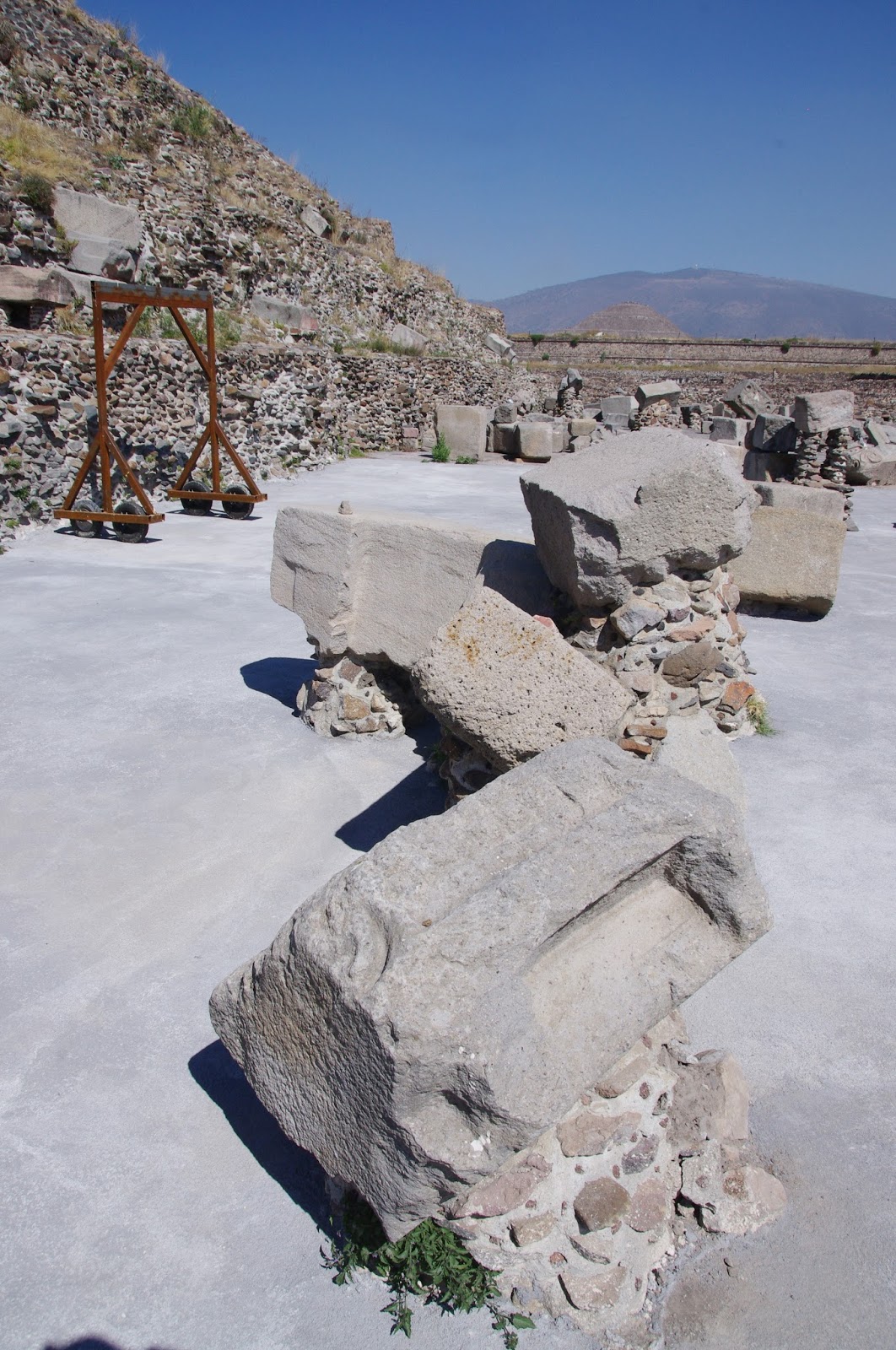
As it can be seen from the pictures below, most of the stones are limestone and would have once formed part of a continuous façade not unlike the portion that is still preserved underneath the “adosada” platform.  Many of the larger stone fragments seem to belong to the familiar snake heads and masks that must have decorated the pyramid on each one of its four sides, but others also bear decorations of a different kind - not found on the other sides of the pyramid wherever its sculptured decoration has survived the ravages of time.

What is perhaps most striking is that these examples of megalithic architecture are almost invariably found in the oldest layers of construction of the ancient metropolis, and we would not rule out the possibility that they might have once formed part of even older, now vanished megalithic structures – perhaps later reemployed by the builders of Teotihuacan of the historical period for their constructions.

An overview of the area behind the pyramid of the feathered serpents, with many of the large megalithic stone blocks lying scattered around its base, each one weighting multiple tons. [Copyrighted picture - No reproduction allowed]
A detailof the state in which many of the stones are to be found, partially embedded in the now demolished filling of the "adosada" platform. Not the curious U-shape of some of the larger blocks. [Copyrighted picture - No reproduction allowed]
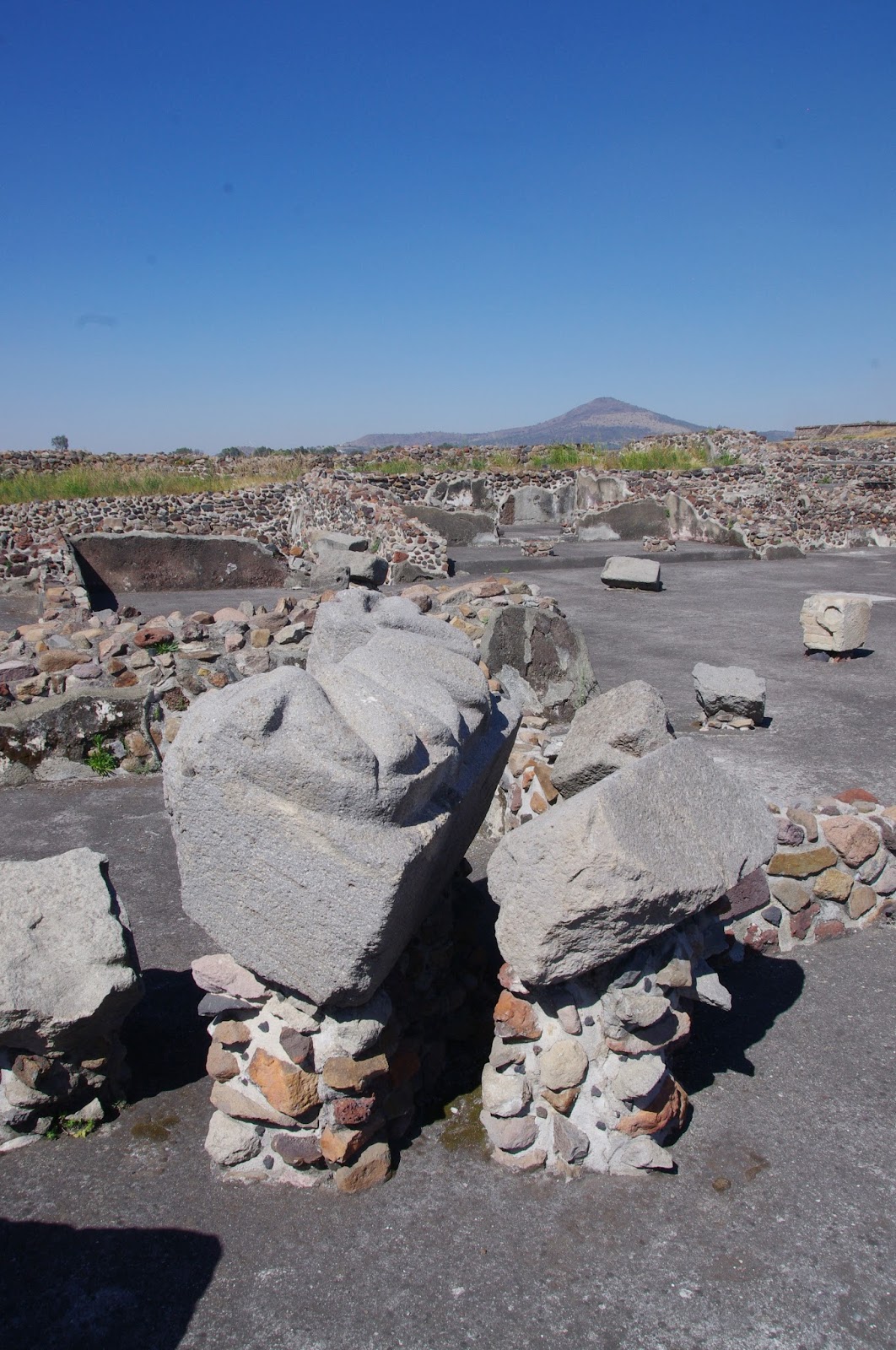
More megalithic stone blocks scattered around the base of the pyramid, some of which bearing the same ornamentation as the blocks found on the main facade of the pyramid, to the sides of the monumental stairway. See for instance the large serpent head in the foreground. [Copyrighted picture - No reproduction allowed]
Some of the stones appear to be badly eroded or deliberately damaged, while others exhibit perfectly smooth surfaces and straight angles. One is left to wonder as the reason why these stones ended up being scattered and reused in the filling of the "adosada" platform. [Copyrighted picture - No reproduction allowed]
Echoes of the fifth sun

In the legends and myths of the Aztecs, Teotihuacan was the place where the gods convened to give birth to the Fifth Sun of our era, after a previous world age had ended in darkness. It is in that remote age that we need to look for the unknown megalithic builders of Teotihuacan.

According to a story that was told and copied by Bernardino de Sahagún soon after the conquest:

They say they came to this land to rule over it…they came from the sea on ships, a multitude of them, and landed on the shore of the sea, to the North…from there they went on, seeking the white mountains, the smoky mountains…led by their priests and by the voice of their gods. Finally they came to the place that they called Tamoanchan…and there they settled for some time…but it was not for long, for their wise masters left, took again to their boats…bringing back with them all their holy books and their sacred images[3]

If we are to believe the informers of Sahagún, the builders of Teotihuacán-Tamoanchan had come from the sea, and had brought with them the principles of all arts and sciences. Did they also bring knowledge of megalithic architecture with them?

The beginnings of Teotihuacan are obscure. Monumental architecture on the site sprung almost immediately, in a single spree of construction that resulted in the general layout of the site as we appreciate it today, with its three main pyramids distributed along the 3-miles stretch of the Avenue of the Dead.     

New constructions were added on top of the older, but always following the same grand plan drawn by the original unknown founders of the city, perhaps centuries or even thousands of years earlier.

Perhaps these scattered megalithic remains are all that is left of the original City of the Gods.

References:
[1] From a Drawing in BNAH, inv. 58, 21x30.7 cm
[2] William Bullock, Six months Residence and Travel in Mexico, p. 416 (London, J. Murray, 1824)
[3] Bernardino de Sahagún, Codice Matritense de la Real Academia, folio 191,192

A detail of a large monolithic serpent head from a complex of buildings along the Avenue of the Dead. All over Teotihuacan and ancient Mesoamerica, the most sophisticated architecture is always found in the lower occupational layers. In this case, the floor level was raised when a new platform was built on top of the already existing one, thus covering and preserving its beautiful stone ornamentation. [Photo by Author] 
From this other perspective of the same building, it is easy to appreciate how the older construction (below the later floor level) exhibits a much superior workmanship and architectural technique, with the use of larger, sometimes even megalithic stones. [Photo by Author]
One of many architectural fragments preserved in the "Jardin Escultorico" of the site. This one in particular bears a very elaborate ornamentation and might have been part of a larger sculptured monolith, of which it is the only surviving fragment. [Photo by Author]
More interesting sculptural fragments from the "Jardin Escultorico". This one is carved in a way similar to the crown of feathers placed around some of the giant serpent heads that decorate the facade of the pyramid of the feathered serpents, a few hundred meters to the South. [Photo by Author]
Slightly off the beaten path, one finds literally hundreds of fragments of sculptures, with varying degrees of finish and polish. Unfortunately there is no information provided on the provenance of these fragments. [Photo by Author]
Some of the architectural fragments aligned on one side of the inner courtyard of the Ciudadela, near the pyramid of the feathered serpents. [Copyrighted picture - No reproduction allowed]
More of the elaborately carved stone blocks lying in the courtyard of the Ciudadela. Not the very fine polish and finish of some of the larger stones in the foreground. [Copyrighted picture - No reproduction allowed]
This picture, taken from one side of the pyramid of the feathered serpents, clearly shows the exposed nucleus of the pyramid , with its elaborate architectural ornamentation, with the remains of the "adosada" platform clearly visible to its left. The empty space between the two is a result of  20th Century restorations. [Copyrighted picture - No reproduction allowed]
A particular of the sculptured decoration of one of the outer faces of the pyramid of the feathered serpents, where large and carefully fitted stone blocks are clearly visible embedded in the more incoherent masonry that constitutes the core of the pyramid. [Copyrighted picture - No reproduction allowed]
Some of the large megalithic stone blocks lying in the esplanade behind the pyramid of the feathered serpents. Not the large serpent head and body in the foreground, as well as the many other beautifully carved and sculptured stone blocks. [Copyrighted picture - No reproduction allowed] 
Another view of the chaos of megalithic stones lyng around the base of the pyramid of the feathered serpents. [Copyrighted picture - No reproduction allowed]
Of the several sculptured fragments lying around the base of the pyramid, many are found still partially embedded in the masonry fill of the pyramid, as if they had been simply dumped there after the demolition of the original construction. [Copyrighted picture - No reproduction allowed]
This enormous stone, one of the largest on the site, was probably part of a continuous frieze. No similar ornamentation exists on any one of the other preserved stone blocks that decorate the main facade of the pyramid. This stone might belong to an entirely different construction. Perhaps it formed part of the temple that would have originally stood on top of the pyramid and of which no other trace survives to this day. [Copyrighted picture - No reproduction allowed] 
Even this comparatively small fragments shows the very fine quality and workmanship of some of the stones, all apparently carved in complex tridimensional patterns as part of a gigantic architectural composition. [Copyrighted picture - No reproduction allowed]
A curious mask carved on a large megalithic stone block. An almost identical carving is found in the site Museum of Teotihuacan. [Copyrighted picture - No reproduction allowed]
More of the very large megalithic stone blocks still lying in their original position  where they were dumped into the masonry fill of the "adosada" platform (now demolished). Are we looking at the remains of deliberate destruction, a kind of damnatio memoriae, or was perhaps a cataclysm responsible for the collapse and ultimate abandonment of these structures? [Copyrighted picture - No reproduction allowed]
Another view of the same area with more of the large megalithic stone blocks still partially embedded in the later masonry fill of the pyramid. [Copyrighted picture - No reproduction allowed]
Particular of a stone block with a motif resembling a crown of feathers or petals like the ones that encase the serpent heads placed on the main facade of the pyramid. [Copyrighted picture - No reproduction allowed]
Another of the large U-shaped stone blocks lying above a broken serpent head still embedded in the later masonry fill. The serpent head block would have originally been inserted amidst two U-shaped stone blocks forming a crown around it. [Copyrighted picture - No reproduction allowed]  
Particular of a stone block with a motif resembling a crown of feathers or petals like the ones that encase the serpent heads placed on the main facade of the pyramid. Note the very fine workmanship of the tridimensional pattern on the stone. [Copyrighted picture - No reproduction allowed]
Another view of the chaos of megalithic stones lyng around the base of the pyramid of the feathered serpents. [Copyrighted picture - No reproduction allowed]
Another view of the chaos of megalithic stones lyng around the base of the pyramid of the feathered serpents. [Copyrighted picture - No reproduction allowed]
Particular of one of the few other areas of cut stone architecture at Teotihuacan, this time a stairway leading to a palatial building on one side of the Avenue of the Dead, near the Plaza of the Moon. The quality of the stone architecture visible here is a very sharp contrast to the poor construction of the building behind. An older layer of construction is also visible in the background under the later masonry filling. [Copyrighted picture - No reproduction allowed] 

Friday, July 31, 2015

The pyramid of Xochicalco: A monument to the end of times

Does the pyramid of Xochicalco tell the history of Atlantis?
The pyramid of  the feathered serpents at Xochicalco, as seen from the front, with the main stairway facing West. [Photo by Author]
                Does the pyramid of Xochicalco tell the history of Atlantis? This apparently outlandish claim first appeared in the works of British-American antiquarian and amateur archaeologist Augustus Le Plongeon (1825 – 1908) around the year 1880. A fervent believer in the history of Atlantis himself, Le Plongeon believed the Maya area to be the true cradle of civilization, which then spread from there to ancient Egypt and the Mediterranean world, through the fabled lost continent. Nowadays, Le Plongeon is mostly remembered (other than for his priceless collection of early photographs and daguerreotypes of ancient Maya sites) for his fanciful translations of the Troano (Tro-Cortesianus) codex, which he also believed told the history of the destruction and sinking of Atlantis. [1]

Le Plongeon also took a keen interest in the so called “Pyramid of the feathered serpents” at Xochicalco, which resulted in the publication of a posthumous book in 1914, with the title “The Pyramid of Xochicalco”.
Although the translation provided for the glyphs, at a time when Maya and ancient Mesoamerican studies where still in their infancy, is no less fanciful than the one he made of the Troano codex, many authors have ever since quoted his claims to support the most various theories.

As Le Plongeon’s interpretation of Maya writing has been now thoroughly discredited and dismissed as a romantic flight of fantasy (at best), still the question remains. What is the message of the pyramid of Xochicalco? And more important, is it somehow connected to Atlantis?

The pyramid of Xochicalco

                The ancient site of Xochicalco, in the highlands of Morelos and a short drive from the state’s capital of Cuernavaca, is visited by hundreds of tourists every day. Its present name was given to it by the Aztecs, meaning “Hill of Flowers”. Between 650 and 900 AD, Xochicalco was one of the major city-states in central Mexico that tried to fill the power void left after the fall of Teotihuacan.

The major ceremonial center was built around that time as a large acropolis occupying the summit of a natural eminence.  Among the many remains of monumental architecture at Xochicalco are several pyramids, three ball court games, as well as palaces and residential areas occupied by the priests and the nobility. Massive stone walls surround the site, forming the terraces of the acropolis, a clear hint to Xochicalco being also an important military stronghold.  

The "plaza of the two glyphs" at Xochicalco. The name comes from a stela bearing the glyphs "10 reed" and "9 eye of reptile". The plaza was built on a set of artificial terraces and faces the largest pyramid at the site, a massive stepped pyramid, built in the typical Talud-Tablero Teotihuacan style. [Photo by Author]
Another view of the main pyramid, as seen from the plaza of the two glyphs. The very broad stairway in the front was one of the few monumental accesses to the acropolis. [Photo by Author]
Some of the artificial terraces and retaining walls of the main acropolis. A fortified site, Xochicalco occupied a very strategic position along the major trade routes connecting the two Oceans - the Pacific and the Atlantic - across the Mexican highlands. [Photo by Author]
All the main entrances to the acropolis were closely guarded. Guard posts were placed at all the main entrances. Some very intense fighting seems to have taken place at this particular spot, where about 20 human skeletons were found under the collapsed roof of the main gate house; probably the consequence of a fire started by the attackers. [Photo by Author]
Another view of the impressive system of artificial terraces and fortifications leading up to the acropolis of Xochicalco. The summit of the hill was artificially leveled in order to create a large platform that served as the foundation for several smaller pyramids and temples, and also housed large palace structures. [Photo by Author]
The reasons of the fall and abandonment of Xochicalco might never be known or fully understood. Certainly, the city had a violent ending around 1100 AD, with extensive traces of burning and looting. Whether that was the work of foreign invaders or the product of an internal revolt of the lower classes against the ruling elite, is still the matter of considerable debate. In support of this later interpretation, all signs of violent devastation seem to be limited to the elite areas of the city and the acropolis, whereas the lower class residential areas would seem to have been largely spared. After its sudden abandonment, the city was never reoccupied and survived as a ruin until its modern rediscovery.

The building at Xochicalco that has most attracted the interest of antiquarians and archaeologists, ever since colonial times, is the so called “Pyramid of the Feathered Serpents”, occupying a privileged spot on the acropolis. Already in 1810, Baron Alexander von Humboldt was very moved by the ruins of Xochicalco. Even earlier still, in 1791, José Antonio de Alzate y Ramirez (1737-1799), a clergyman, had published a first sketch of the site, accompanied by drawings of the bas-reliefs decorating the main pyramid, which he took for a military building. Dupaix also published many very fine drawings of the pyramid and the site (after Castañeda) in his monumental Antiquités Mexicaines (1805), which made the ruins of Xochicalco known for the first time to the general public outside of Mexico. Notwithstanding the extensive restoration works carried out in 1910 by Leopoldo Batres, the pyramid doesn’t seem to have suffered any major damages from those early times, with most of the original stones of the first two platforms still remaining in situ.

Another view of the pyramid of the feathered serpents, on the main acropolis of Xochicalco. The pyramids is roughly square at the base, with each side having a length of about 20 meters. [Photo by Author]
A view of the Acropolis of Xochicalco, from the top. The pyramid of the feathered serpents is to the left. [Photo by Author]
The Pyramid of the feathered serpents, or Pirámide de las serpientes emplumadas, as it is known in Spanish, is unique in all of Mesoamerica for being built of large, megalithic basaltic stones, all covered in exquisite bas-relief carvings. An earlier stage of construction is also visible within the now exposed core of the pyramid, although lacking the fine bas-reliefs.

Feathered snakes, lost cities and the Lords of Time

                The pyramid has an East-West orientation, with the main stairway facing the setting sun, and consists in its present state of two superimposed bodies arranged in the typical Talud-Tablero Teotihuacan architectural style. It measures 19.6 by 21 meters at the base, and while the lower level survives almost intact, the upper frieze band is highly fragmentary. Only few decorated stone blocks remain of the actual temple, occupying the second level. Several more decorated stones have not yet found a collocation within the partially restored pyramid, and now lie quite chaotically in a small storage area to its side. 

An artist's impression of how the pyramid of the feathered serpents might have originally looked like (After Brantz Mayer, 1847, Mexico as it was and as it is). Brantz Mayer quotes José Antonio Alzate as stating (in 1777) that "no more than twenty years before, the five terraces of which it consisted were still perfect", but that the work of destruction started by some local farmers had left barely the first terrace and part of the second intact.  
The most striking feature of the bas-reliefs that decorate the lower portion of the pyramid is the undulating serpent motif occupying three of its four sides, a total of 60 meters in length.

The serpent is clearly a symbol of Quetzalcoatl, the legendary culture hero and civilizing god, and this is reinforced by at least two attributes: the cut snail glyph, believed to represent the Wind (in the image of Quetzalcoatl as Ehecatl, the god of Wind), and the glyph 9 “eye of reptile”, itself one of the calendric names of Quetzalcoatl. The coils of the snake are also suggestive of the waves of the Sea, an imagery which is reinforced through the analogy with the pyramid of the feathered serpents at Teotihuacan, itself considered to be the prototype of the one at Xochicalco. At Teotihuacan, the marine imagery is further stressed by the presence of different types of seashells among the volutes of the snakes; which are also recalled at Xochicalco in the form of the cut sea snail glyph (itself the most recurring glyph on the pyramid walls).

The feathered serpent motif on the outer walls of the pyramid of Xochicalco. The serpent appears multiple times on all the four sides of the pyramid, and might be interpreted as a symbol for comets and recurring catastrophes. [Photo by Author]
The same figuration appears on the Southern face of the pyramid. A seated figure, possibly Quetzalcoatl himself in human form, is being carried above the waters on what might be interpreted as a boat of snakes, accompanied by the glyph of the wind. Behind his shoulders, what appears to be a flaming temple on an island is hit by a giant wave and submerged by the waters, again symbolized by the cosmic serpent. The depiction of the sacred island is accompanied by the glyph "9 eye of reptile", associated with the Wind and with Quetzalcoatl as the god of Wind. [Photo by Author] 
According to some interpretations, the giant snake is highly suggestive of a global cataclysm. Astronomers William Napier and Victor Clube argued in their books The Cosmic Serpent and The Cosmic Winter that the mythical imagery of sky serpents and dragons, which is found throughout the world, was in fact a metaphor the ancient astronomers used for comets.  [2]

There is also abundant evidence of the association of Quetzalcoatl with comets. In its starry aspect, Quetzalcoatl was associated with the planet Venus, being the brightest “star” in the night sky. Venus was often referred to as the “smoking star” [3], a name that the ancient Mexicans also associated to comets [4]. This makes Quetzalcoatl also an astral deity, somehow associated with wind, fire, the planet Venus and comets (as well as, interestingly, with water).

The other most recurring imagery on the lower band is a curious set of glyphs, appearing a total of 6 times within the coils of the snake. This set of glyphs contains the calendric date “9 eye of reptile”, also associated with Quetzalcoatl, surmounted by what appears to be a temple from which emanate large tongues of fire. Interestingly, a glyph in the shape of a volute, emanating from the serpent’s tail, appears to be hitting the temple as a giant wave. Similar volutes are also to be seen underneath the temple, as if the intent of the artist was to represent the construction sinking underneath the waves.
An enlarged detail of the glyph combination that we suggest might represent the original homeland of the gods, the "Island of the Winds", in its final moments before its sinking. Great flames rise from the temple on top, while the wave-like symbols underneath it might suggest the idea of it sinking or being submerged by the waters. The tail of the cosmic snake takes the form of  a giant wave, hitting the temple from the East. The glyph "9 eye of reptile", inserted within a cartouche, might hint to the original name of the island as the "Island of the Winds". [Photo by Author]
The overall picture is a highly suggestive of a fiery catastrophe terminating in a giant flood that consumed the original homeland of the gods.

A seated figure, possibly Quetzalcoatl himself in human form, is depicted 10 times among the volutes of the snake. The posture, with the legs crossed, and the hand gestures are highly reminiscent of Maya royal iconography, and there are words coming out of the mouth of the seated figure in the form of speech. It is as if the figure was being carried by the waves - that is, the serpent coils – on top of what might be interpreted as smaller serpent or snake-like forms in the shape of the letter S. There might be a connection here with the legend of Quetzalcoatl sailing across the ocean towards the setting sun on a boat of snakes. There is also a curious resemblance with the Olmec Monument 19 of La Venta, dating between 1200 and 800 BC and considered the earliest known representation of the feathered serpent in Mesoamerica.   

Another enlarged detail of the seated figure, whom we might interpret as Quetzalcoatl in his human form. The curious shapes underneath the figure resemble the "boat of snakes" that the legend associates with the departure of Quetzalcoatl from Tollan. [Photo by Author]
The upper frieze, occupying the tablero portion, shows a number of similarly seated features accompanied by the same enigmatic set of glyphs. These figures have been called the “Lords of Time”, as they bear attributes usually associated with the year. There were probably 22 of those, but the sequence is fragmentary, with many of the original stones missing. They all seem to carry a sort of bag, again highly reminiscent of the iconography found on the Monument 19 of La Venta. To their right, is a glyph showing of a circle divided into four quarters, with an open jaw to its side.  There is no agreement about the meaning of those glyphs, but they seem suggestive of place names.

A detail of one of the "Lords of Time" depicted on the lower Tablero. The seated pose is similar to that of Quetzalcoatl in the lower Talud, but the human figure here now carries a headdress with the trapeze and ray sign for the year, and a curious "bag" in his left hand (compare with the Olmec bas-relief below from La Venta). The open jaws with the circle divided in four are conventional signs believed to accompany important place names. According to our interpretation, this section should be read as a list of the cities founded by the gods after the deluge that destroyed their insular homeland. [Photo by Author]
One of the earliest depictions of the feathered serpent from Mesoamerica. Dating between 1200 and 800 BC, the so called "Monument 19" of La Venta shows a figure wearing an elaborate headdress, seating within the coils of a giant snake and carrying a highly enigmatic "handbag", which finds its parallel in the bas-reliefs of Xochicalco. [Photo by Author, Museo Nacional de Antropología, Mexico City]
The bas-reliefs of the uppermost surviving registry, comprising the second layer of the pyramid – or what was possibly the inner temple chamber – are too incomplete to hazard any kind of reconstruction. Again there appear the usual seated figures with their legs crossed, wearing some sort of large hats or turbans and a carrying a staff. The interpretation of these figures as military lords is reinforced by the set of three arrows and a shield that they carry in front of them. Unless, of course, these items have a different ritualistic meaning that we do not yet understand.

Some of the glyphs and bas-reliefs that decorate the upper portion of the pyramid, possibly the depiction of military Lords or deified ancestors. [Photo by Author]
Each one of the great Lords depicted on the uppermost surviving level of the pyramid is shown as carrying a staff of command, with a set of arrows and a rectangular shield covering the chest. The headdress, similar to a large turban, is also very peculiar. [Photo by Author]
 Another glyph in particular – one of the few surviving from the upper portion – deserves attention. It shows what would look like a man with only the head emerging from the water – again more imagery associated with the idea of a deluge.


This glyph, from the South-East corner of the pyramid, shows a man of which only the head is visible above the water. Yet another depiction of a deluge? [Photo by Author]
The conventional interpretation of the glyphs

                Although there is no agreement among scholars on the meaning of the bas-reliefs and glyphs of the pyramid of Xochicalco, two main interpretations have emerged; that of a genealogy of rulers and of a correction to the calendar.

The genealogy of rulers interpretation is quite straightforward in that it sees in each one of the seated figures the representation of a lineage of kings, connected by the symbol of the feathered serpent and each one accompanied by a date glyph. This is a rather simplistic explanation of the very complex symbolism of the pyramid bas-reliefs, and does not moreover account for the hundreds of other glyphs and carvings that do not seem to be associated with the images of the assumed rulers or kings.

The second hypothesis of interpretation is based on a specific tablero located to the left (North-East) of the main access stairway of the pyramid.  In it, a glyph is found which can be interpreted as the date “5 Calli” or “5 House”, which is tied by means of a rope to another date glyph “11 Ozomatli” or “11 Monkey”. This is somehow interpreted as the “pulling” of a date, that is to say, a recalibration or adjustment to the sacred calendar. The pyramid would therefore represent (and was built in order to commemorate) an astronomical conference, or a meeting of the “Lords of Time” from all over Mesoamerica in Xochicalco to decide on the calendar correction – that is, as the calendar had apparently gone out of sync with astronomical observations. This event is believed to have occurred sometime around the year 743 AD, when the pyramid was dedicated. This interpretation was first suggested by Enrique Juan Palacios in 1920, and later supported by renowned archaeologist Roman Piña Chan in his doctoral thesis in 1970.

A particular of the combination of glyphs from the left Tablero, in which the calendric glyph "5-Calli" appears to be pulled by the glyph "11-Ozomatli" by means of a rope. This is commonly interpreted as the depiction of a calendric correction or adjustment, but this interpretation is by no means certain. [Photo by Author]  
Starting from the 1970s, however, skepticism started to emerge in the academic community towards this reading of the glyphs. Hanns J. Prem (1974), firmly denies this interpretation, and the whole subject of the glyphs of Xochicalco seems to have become the matter an archaeological taboo ever since. In a 1994 article, Mexican archaeologist Ruben Morante Lopez goes as far as saying that since then “The majority of studies on the Mesoamerican calendar and the history of Xochicalco barely mention the tablero, and do not dare to take a stance on the very tricky matter of the interpretation of those glyphs”. [5]

An alternative interpretation

Another view of the pyramid of the feathered serpents, on the main acropolis of Xochicalco. The relative position of the different superimposed levels can be easily appreciated, as well as the sequence of the main bas-reliefs. [Photo by Author]
                Here I will propose an alternative interpretation of the glyphs and bas-reliefs based on the idea that the pyramid of Xochicalco contains a mythical account of historical events, which does not by itself exclude other interpretations of portions of the glyphs as related to the sphere of astronomy or to the calendar.

Lower Talud

                 As noted earlier, the cosmic serpent, itself the most prominent feature on the pyramid, can be interpreted as the metaphor for a comet and a deluge (the undulating movement) – the two being possibly interconnected – and might therefore be taken as the symbol of a global catastrophe. The obsessive repetition of the same motif on the four faces of the pyramid could, in turn, hint at the cyclical nature of such global catastrophes, brought by comets or other celestial bodies.
The flaming temple, overthrown by the waves and sinking in the waters appears to be an allusion to a lost “Land of the Gods”, identified by the glyph “9 eye of reptile”, and associated with wind and Quetzalcoatl (as the god of wind). The name of this mythical island might have been therefore “Island of the Winds” if we take the glyphs for their literal value.  This is again obsessively repeated for a total of 6 times on 3 of the 4 sides of the pyramid. 

A deluge seems therefore to have been responsible for the final destruction and sinking of the island of the gods, after it was first hit by a fiery catastrophe (the high flames rising from the temple) possibly caused by the impact of a large celestial body, such as a comet.    

The seated figures (10 in total), could represent the survivors from this catastrophe leaving towards the different cardinal directions and spreading into the world, carried by the waves (on what appears to be a boat of snakes, again reminiscent of the legend of Quetzalcoatl). This company of gods or demi-gods, whose leader can be identified as Quetzalcoatl – the feathered serpent – (himself depicted in a sort of “boat” on the sides of the main entrance stairway), was probably at the origins of the city of Xochicalco, or seen perhaps as a mythical ancestor to the city’s royal lineage.  

A detail of the right Tablero, towards the South-West corner. A rather curious glyph amid the coils of the snake is believed to represent the figure of a "Sky bearer", carrying upon his shoulders a starry sky glyph. [Photo by Author]
A general view of the Southern side of the pyramid of the feathered serpents, as taken from the South-West corner. [Photo by Author]
Lower Tablero

                The frieze occupying the entire length of the Tablero of the lower platform would have originally contained 22 depictions of the “Lords of Time”, each one associated with a specific glyph indicating a place name. This could be interpreted as an account of the mythical foundations of the gods, a list of cities founded by the same company of gods depicted in the lower Talud upon their arrival in Mexico. Each one of these “Lords of Time” carries a peculiar bag, which might be interpreted as a bag containing the metaphorical seeds of civilization, or a symbol related to the introduction of agriculture – itself one of the gifts of civilization brought by Quetzalcoatl to ancient Mexico. The peculiar hat that they seem to be wearing contains the symbol of the year, in the tradition of Teotihuacan, a symbol usually associated with great Lords, and perhaps with astronomy. There also seems to be a snake head coming out from the front. Interestingly, each one of these figures seems to be wearing some sort of “goggles” or “eye-glasses”, itself a symbol commonly found in ancient depictions of Tlaloc, the god of rain. Perhaps more curious, the strange figures appear to be bearded.  

Upper Talud

                This whole section is very fragmentary, but contains depictions of what are usually interpreted as military Lords, each carrying a staff, a shield and a set of three arrows. These might be the lords of Xochicalco and other places, who inherited rulership over the land directly from the gods. The very complex symbolism and glyphs associated with this figures suggests however there might be something else. One interpretation is that the figures on this level of the pyramid have to do with the “gifts” of the gods, which might explain the vegetal motifs of what appear to be crops, the calendric glyphs as well as the other animal figures. So far, there are not enough elements to attempt a satisfactory interpretation of this section of the pyramid.

A monument to the end of times?
In this famous mural by Diego Rivera, in Mexico City's Palacio Nacional, Quetzalcoatl is depicted as a civilizing god, the inventor of writing and of the calendar, the god who taught men how to cultivate crops, to wear clothes and live in cities. [Photo by Author; Palacio Nacional, Mexico City]
                If the above interpretation is correct, then the pyramid of Xochicalco might be interpreted as a monument erected to commemorate the mythical ancestry of the lords of Xochicalco, descendants from a company of gods that were the sole survivors of a cataclysm that destroyed and sunk their primeval homeland, the “Island of the Winds”. This cataclysm appears to be related to the impact of a comet or another celestial body, and there is moreover a suggestion of cyclical or recurring cosmic events. In this sense, even the calendric glyphs on the pyramid of Xochicalco might be interpreted as referring to some recurring astronomic event, perhaps the passage of a comet, which was believed to cyclically bring devastation to the world.
The story goes on with the arrival of this company of gods, the “Lords of Time”, to Mesoamerica, where they founded a number of cities and temples, taught agriculture, astronomy and the arts of civilization to the still primitive inhabitants of the valley of Mexico, and also established a lineage of kings to whom the rulers of Xochicalco and other places in Mesoamerica traced back their ancestry and, ultimately, their divine right to kingship.    

A leap to the other side of the Atlantic

A page from the Codex Boturini, showing the mythical migration of the Aztecs from their ancestral homeland of Aztlan, the "place of whiteness" or the "place of reeds and herons", here depicted as an island in the middle of a sea or lake. [Museo Nacional de Antropología, Mexico City]
                This story, if correct, bears some remarkable similarities to other cosmological myths of a global cataclysm from across the Atlantic, particularly to the famous Edfu building texts.  The similarities are so striking that one might be induced to think that the pyramid of Xochicalco and the Edfu building texts do indeed tell the same story.

The Edfu building texts are a collection of hieroglyphic writings found on the outer walls of the Ptolemaic temple of Edfu, in Egypt, dating to the 2nd Century BC. No doubt, however, the Edfu building texts were copied after some much older material, possibly dating to the Old Kingdom. The story told in these ancient Egyptian texts is almost identical to the one represented on the walls of the Mexican pyramid of Xochicalco.
This corpus of texts, which has only been partially translated, also seems to refer to a primeval abode of the gods, which was destroyed in a violent cataclysm and was later submerged. The similarities, however, don’t stop here.

In the Edfu building texts, this primeval “Land of the gods” is depicted as an island, variously called “Island of Creation”, “Island of Trampling”, “Island of Combat”, “Island of Peace” or “Island of the Egg”, names that might all possibly relate to mythical events in the island’s history. This island, the original abode of the gods and seat of the first, mythical ancestor of the Temple, appears to have been destroyed in a violent attack by a “snake” or “serpent”, which caused the island to split and sink in the primeval Ocean, causing all of its divine inhabitants to perish. 

According to E.A.E. Reymond, author of The Mythical Origins of the Egyptian Temple:

The homeland of the primeval ones […] having been constituted by the creators themselves, came to its end at a definite moment of the primeval age. A storm, perhaps, came over the island, during which an attack was made by an enemy pictured as a snake. The aggression was so violent that it destroyed the sacred land with the result that all of its divine inhabitants perished[6]

Concerning the “snake” itself, which was apparently responsible for the destruction and sinking of the island, she adds:

He refers to a snake, the nhp-wr, the Great Leaping One, who appears to be the chief enemy of the god […] his feet were pierced and the ground of the domain was split. This is a clear picture of a disaster[7]

The attack was so violent that it caused the primeval island of the gods to sink and be submerged:

The primeval water might have submerged the island as a consequence of a fight, and the island became the tomb of the original divine inhabitants[8]

This serpent, also called in the Egyptian text “The Great Leaping One” is highly reminiscent of the feathered serpents depicted on the outer faces of the pyramid of Xochicalco, which can be interpreted as a metaphor for comets. There is also an idea in the Edfu text of recurring catastrophes, as the text explicitly references multiple cycles of creation and resurrection of the primeval island.

The “company of gods” that survived the destruction and sinking of the primeval island of creation (otherwise known from other Egyptian sources as the Shemsu-Hor – the companions of Horus), seems to have played a role in the rebirth of civilization after the catastrophe which is very similar to the one attributed in Mesoamerica to Quetzalcoatl and his companions.

There is also another striking analogy in the names used to describe the new homeland of the gods after the catastrophe. The Edfu text mentions that reeds were all that survived of the primeval island of the gods after its sinking, and that the island itself was covered in reeds:

The beginning of the first Edfu record does not tell us that the new generation of creators arriving in the island would perceive the island itself when the sun shone once more on the primeval waters. It is stated that they saw only the reeds on the surface of the water[9]

And also:

The Edfu cosmogonical records begin with a picture of the primeval island where the gods were believed to have lived first…which, in part, was covered with reeds[10]

Interestingly, the mythical capital of Quetzalcoatl after his arrival in Mexico was called Tollan, which in Nahuatl means “the place of reeds”. Tollan was considered an ancestral place of origin for the civilizations of Mexico, and was the legendary capital of the Toltecs (meaning “people of the reeds”). The very name of Quetzalcoatl is often associated with the glyph “Ce Acatl”, or “1 reed”, with the reed glyph appearing several times on the pyramid of Xochicalco itself.

In Aztec myths, the original homeland of the Aztec people is named “Aztlan”, a name somehow associated with the color white, whose literal meaning is “place of herons and reeds”. One might also find interesting, and it is certainly matter of speculation, that while the ancient Egyptians located the homeland of the Gods in the far West, Quetzalcoatl was believed to have come to America from the East, that is from across the Atlantic. It is on the coast of the Gulf of Mexico that the earliest known Mesoamerican civilization, the Olmecs, developed, and it is with the Olmecs that the earliest depictions of the feathered serpents are found.

Perhaps the pyramid of Xochicalco does not tell the same story as Plato’s Atlantis, but the parallels with the ancient Egyptian myths from across the Atlantic, and the Mesoamerican legend of Quetzalcoatl as a civilizing god who came from the East, all point to a common belief in a primeval homeland of the gods, that was destroyed and sank in a time beyond recorded history, from which civilization spread to both the Old and the New World.

A panoramic view of the Northern side of the pyramid of the feathered serpents at Xochicalco. [Photo by Author]
References:

[1] A good online biography of Augustus Le Plongeon can be found at the following website: http://maya.csueastbay.edu/archaeoplanet/LgdPage/LepKehoe.htm
[2] Victor Clube, Bill Napier, The Cosmic Serpent, Faber & Faber, 1982
[3] For instance, Venus is depicted as a “smoking star” in the Codex Telleriano-Remensis, as well as in the Songs of Dzitbalche, suggesting a connection between Venus and Comets. See Susan Milbraith, Star Gods of the Maya: Astronomy in Art, Folklore and Calendar, University of Texas, 1999
[4] in Nahuatl, “Citlalin popoca”. Source: Remi Simeón, Diccionario de la lengua Nahuatl o Mexicana, 17th edition, México, 2004 (1st Spanish edition 1977)
[5] Rubén Morante López, El Templo de las Serpientes Emplumadas de Xochicalco, no. 94, Universidad Veracruzana (1994), accessed online: http://cdigital.uv.mx/bitstream/123456789/1232/2/199491P113.pdf
[6] E.A.E. Reymond, The Mythical Origin of the Egyptian Temple, Manchester University Press, 1969, p. 113-114
[7] Ibid., p. 113
[8] Ibid., p. 109  
[9] Ibid., p. 109
[10] Ibid., p. 59